
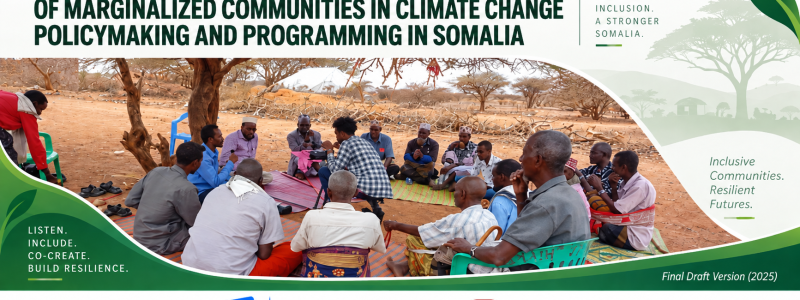
Bareedo Platform Somalia has developed the Participatory Guidance Tool for the Inclusion of Marginalized Communities in Climate Change Policymaking and Programming in Somalia, a practical framework designed to strengthen inclusive, equitable, and participatory climate governance across the country.
The Guidance Tool responds to a critical challenge facing Somalia’s climate governance: communities that are among the most affected by droughts, floods, displacement, environmental degradation, and other climate-related shocks—including women, youth, persons with disabilities, minority communities, and climate-displaced populations—often remain underrepresented in the design, implementation, and monitoring of climate policies and programs.
Recognizing that effective climate action must reflect the experiences, priorities, and knowledge of affected communities, the Guidance Tool provides policymakers, government institutions, civil society organizations, development partners, and communities with practical approaches for embedding meaningful participation throughout the climate policy cycle.
A Participatory and Collaborative Development Process
The Guidance Tool was developed through a participatory, multi-stakeholder, and evidence-based process led by Mr. Abdikhayr Hussein, expert in peacebuilding, climate justice and participatory democracy, between September 2024 and May 2025. The process combined policy and literature reviews, community consultations, institutional collaboration, technical capacity development, and international mentorship.
Bareedo Platform Somalia led the initiative in strategic collaboration with the Ministry of Environment, Range, and Climate Change (MoERCC) of Puntland State, with technical, financial, and mentorship support from People Powered through its Climate Democracy Accelerator (CDA) Program.
Community participation formed a central part of the development process. More than 150 participants were engaged through multi-stakeholder consultations and Focus Group Discussions, including women, youth, minority groups, persons with disabilities, climate-displaced communities, government institutions, civil society organizations, NGOs, research organizations, and private-sector actors.
Dedicated consultations were also organized with marginalized and underrepresented communities to ensure that their lived experiences directly shaped the principles, recommendations, and practical approaches contained in the Guidance Tool.
What the Guidance Tool Seeks to Achieve
The Guidance Tool aims to make inclusion a standard component of climate policymaking rather than an occasional consultation exercise. It seeks to strengthen the ability of marginalized communities to exercise informed and sustained influence over decisions that directly affect their lives.
Its objectives include institutionalizing participatory and equity principles within climate governance systems; empowering women, youth, minorities, persons with disabilities, and climate-displaced populations; providing practical pathways for designing equitable climate interventions; strengthening transparency and accountability; and establishing a model that can be adapted across Somalia’s Federal Member States.
Seven Principles for Inclusive Climate Governance
At the heart of the Guidance Tool are seven interconnected principles intended to guide climate policy development and programming:
Equity, Transparency, Accountability, Intersectionality, Participation, Empowerment, and Localization.
These principles are intended to apply throughout the policy cycle—from identifying climate challenges and developing policies to implementation, monitoring, evaluation, and learning.
The framework emphasizes that participation should go beyond inviting communities to meetings. Meaningful inclusion requires marginalized groups to have the capacity, resources, representation, and influence necessary to help shape decisions and outcomes. Participation therefore moves from consultation toward co-decision-making and community ownership.
A Six-Step Practical Roadmap
To help institutions translate these principles into practice, the Guidance Tool introduces a six-step roadmap for engaging marginalized communities throughout climate policymaking and programming. It covers:
- Stakeholder Mapping and Identification – ensuring vulnerable and marginalized groups are identified and represented from the beginning.
- Participatory Needs Assessment – understanding communities’ vulnerabilities, priorities, capacities, and lived experiences.
- Participatory Planning – involving affected communities as active co-designers of climate policies and solutions.
- Policy Integration – translating community recommendations into measurable policy commitments, targets, and indicators.
- Capacity Strengthening – building climate literacy, leadership, advocacy, and organizational capacity among marginalized communities.
- Feedback Loops and Accountability Mechanisms – establishing mechanisms through which communities can monitor implementation, raise concerns, provide feedback, and hold institutions accountable.
The final stage encourages practical mechanisms such as accessible hotlines, WhatsApp channels, public meetings, community scorecards, grievance systems, and annual inclusion reviews to strengthen continuous communication between communities and policymakers.
From Participation to Inclusive Climate Action
The Guidance Tool goes beyond consultation by addressing implementation, institutional responsibilities, monitoring and evaluation, inclusion indicators, participatory monitoring, transparency, learning, replicability, and pathways for institutional adoption.
Its implementation approach is intended to help institutions test and scale participatory climate governance practices while ensuring that climate interventions respond to local realities and community priorities.
By embedding inclusive approaches within climate policymaking, the Guidance Tool seeks to contribute to socially equitable climate action, stronger public trust, accountable institutions, empowered communities, and locally owned adaptation solutions.
Advancing Climate Justice in Somalia
Climate change is not only an environmental challenge for Somalia; it is also closely connected to inequality, displacement, livelihoods, peace, governance, and social justice. Inclusive policymaking can improve the relevance and sustainability of climate interventions, strengthen social cohesion, increase public accountability, and advance climate justice and human rights.
Through this Guidance Tool, Bareedo Platform Somalia is promoting a model of climate governance in which affected communities are not simply beneficiaries of climate programs, but active partners in identifying challenges, designing solutions, monitoring progress, and shaping decisions.
The long-term ambition is to contribute to climate governance systems across Somalia that are participatory, transparent, accountable, locally grounded, and responsive to the voices of those most affected by climate change.
Bareedo Platform Somalia appreciates Mr. Abdikhayr Mohamed Hussein, a peacebuilding, climate justice, and participatory governance expert, People Powered, and the Ministry of Environment, Range and Climate Change of Puntland State for their leadership, technical guidance, and contributions throughout the development of the Guidance Tool.
Inclusive climate action means ensuring that no one is left behind in Somalia’s climate resilience journey.