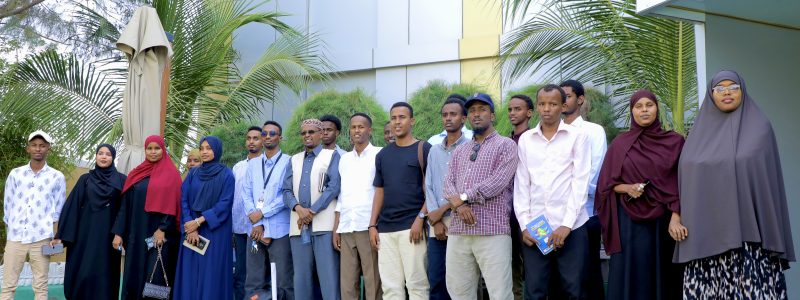
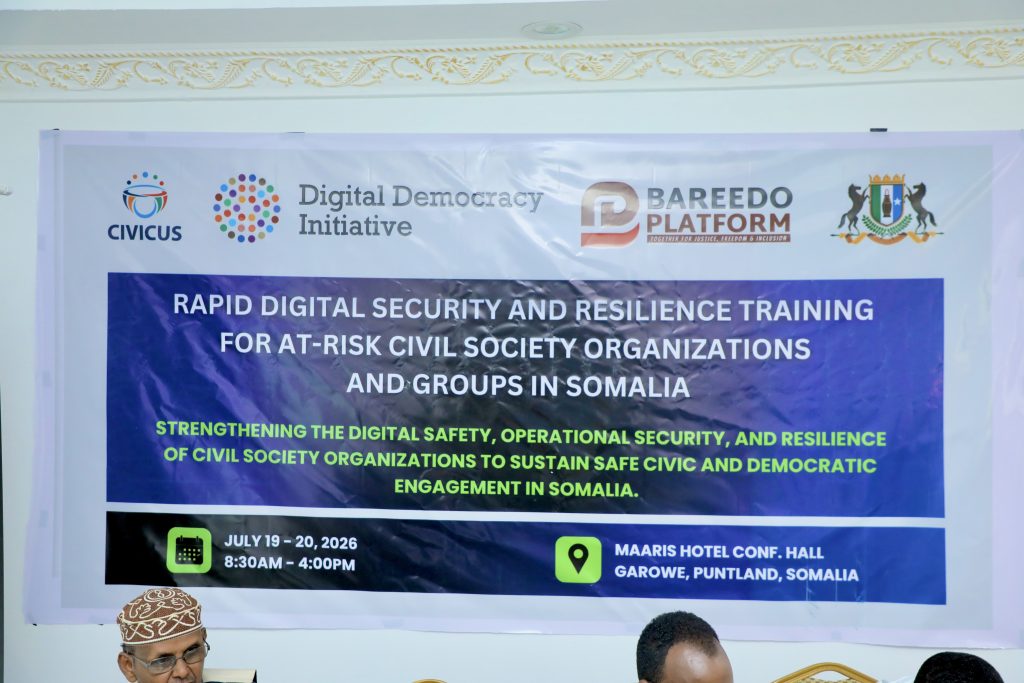
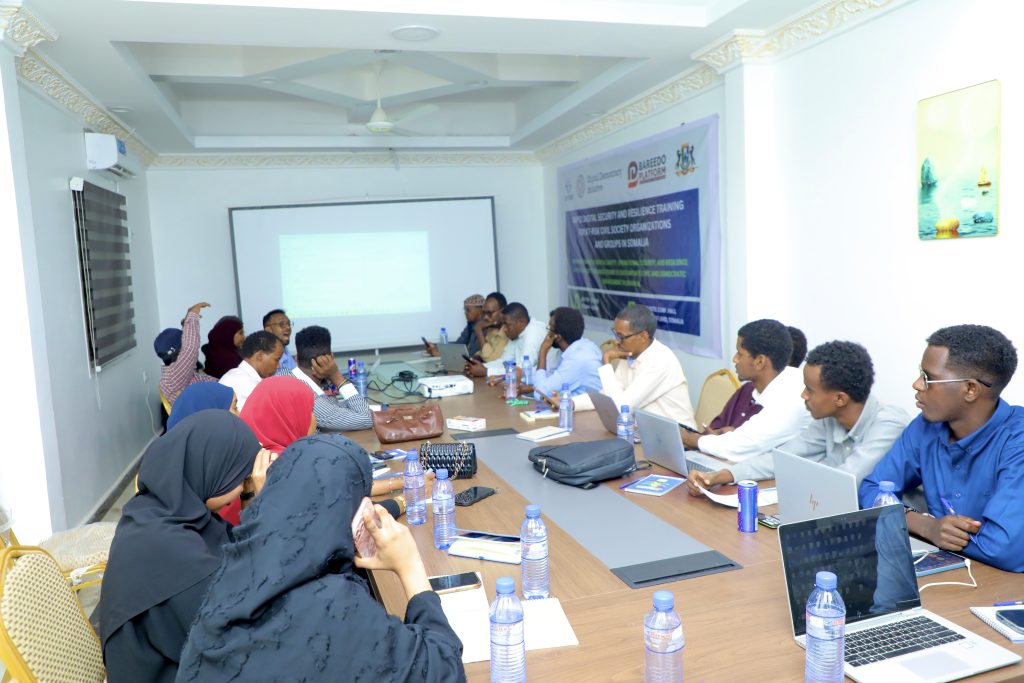
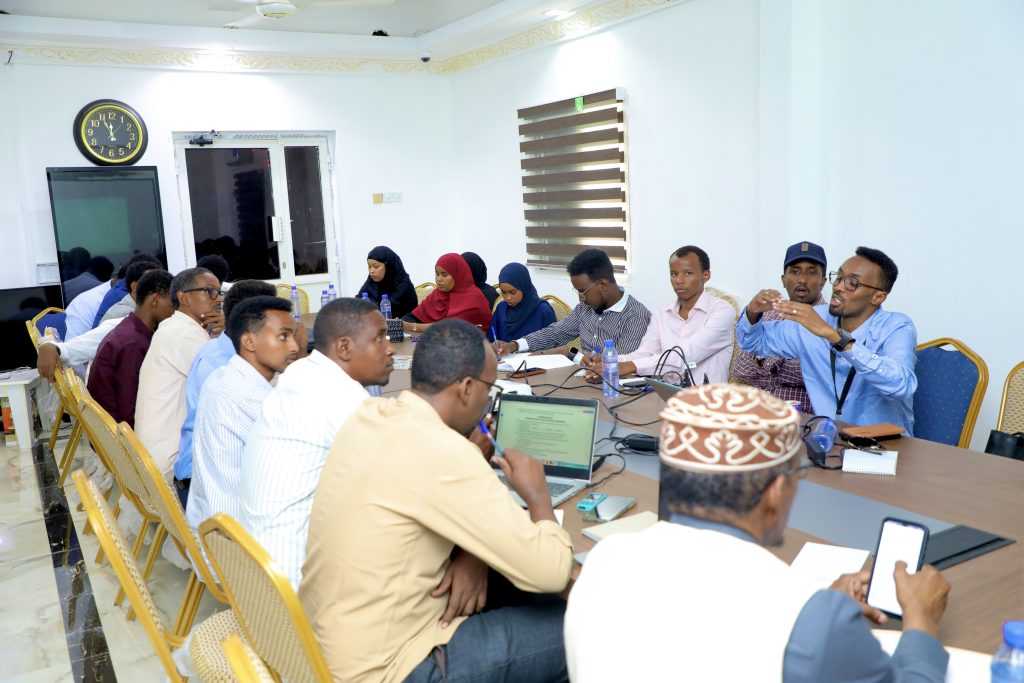
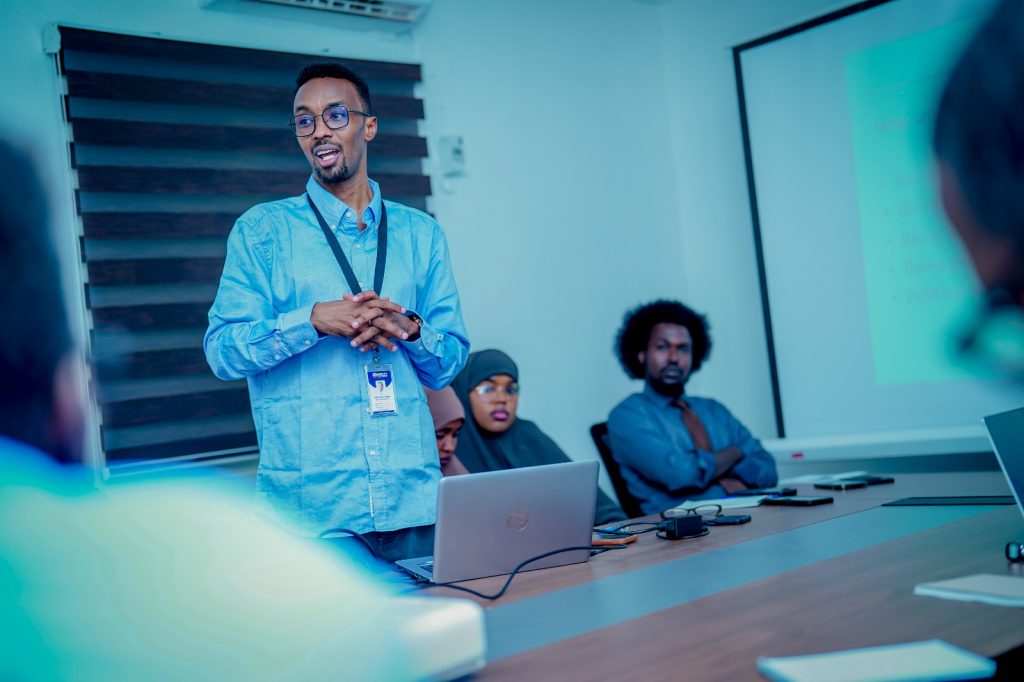
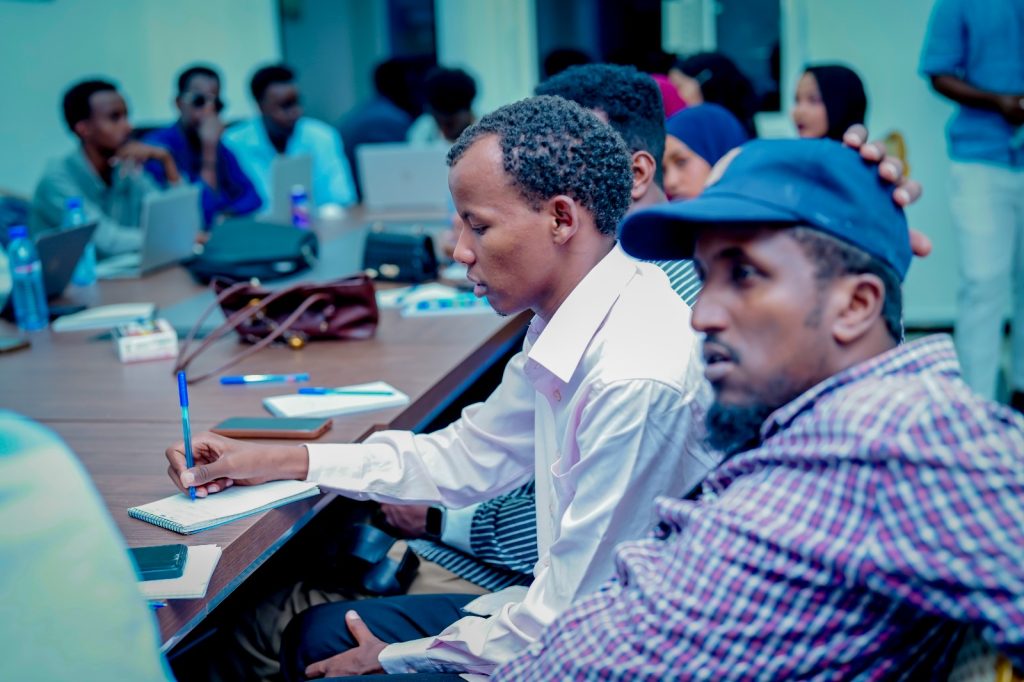
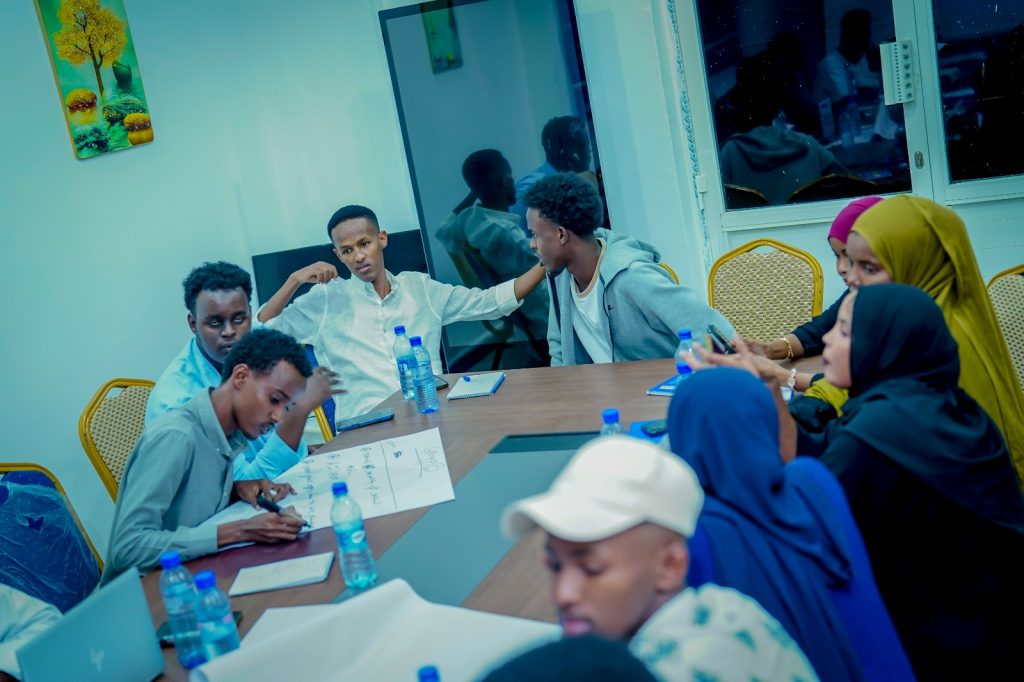
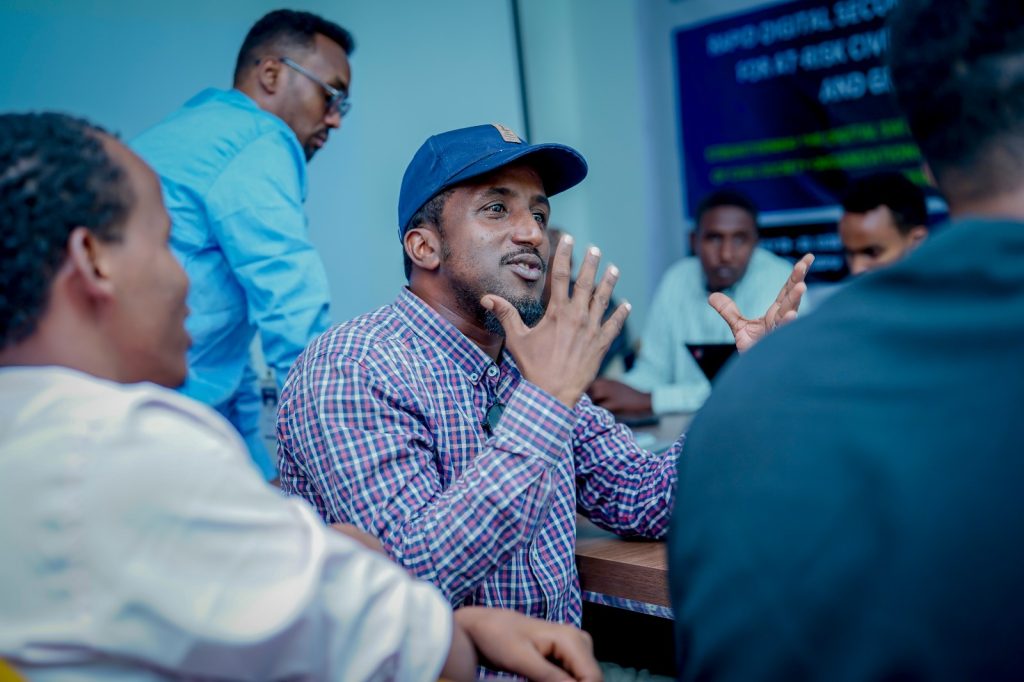
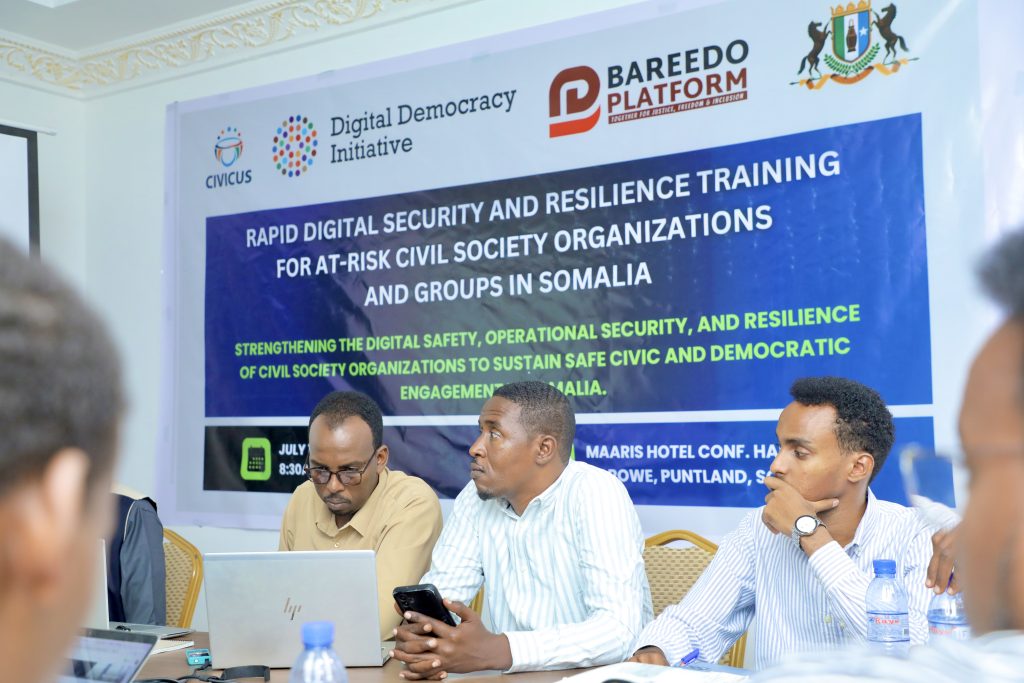
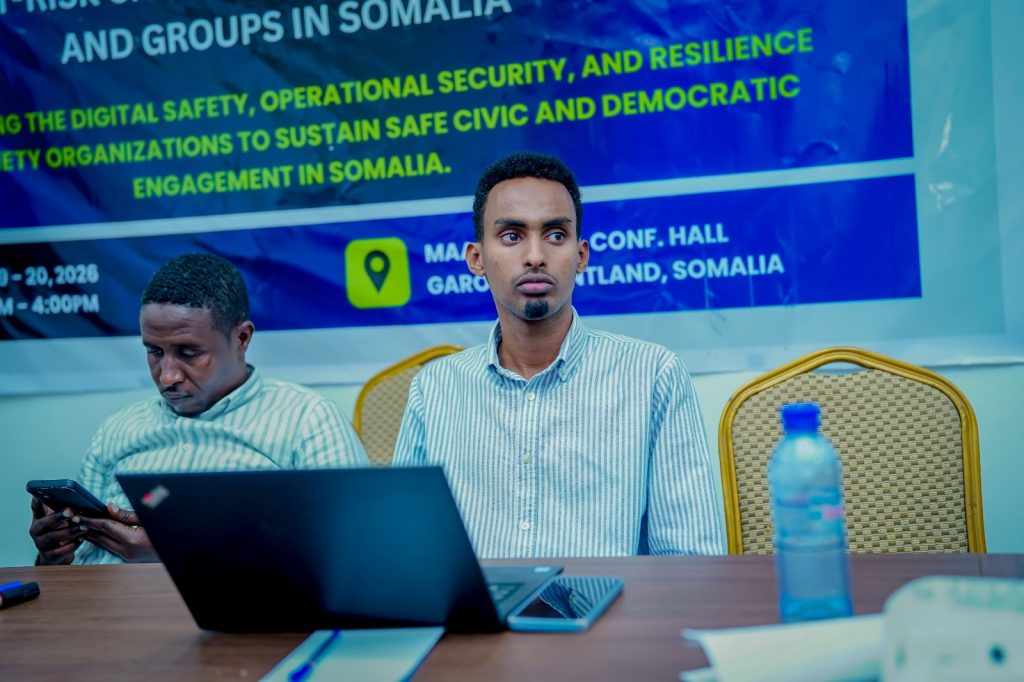
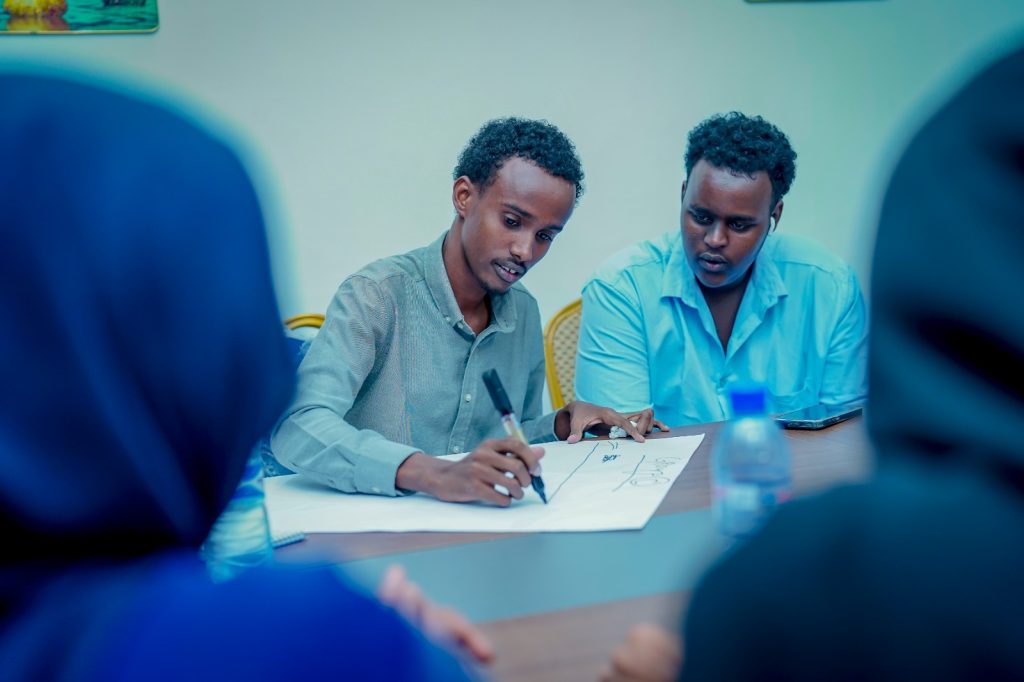
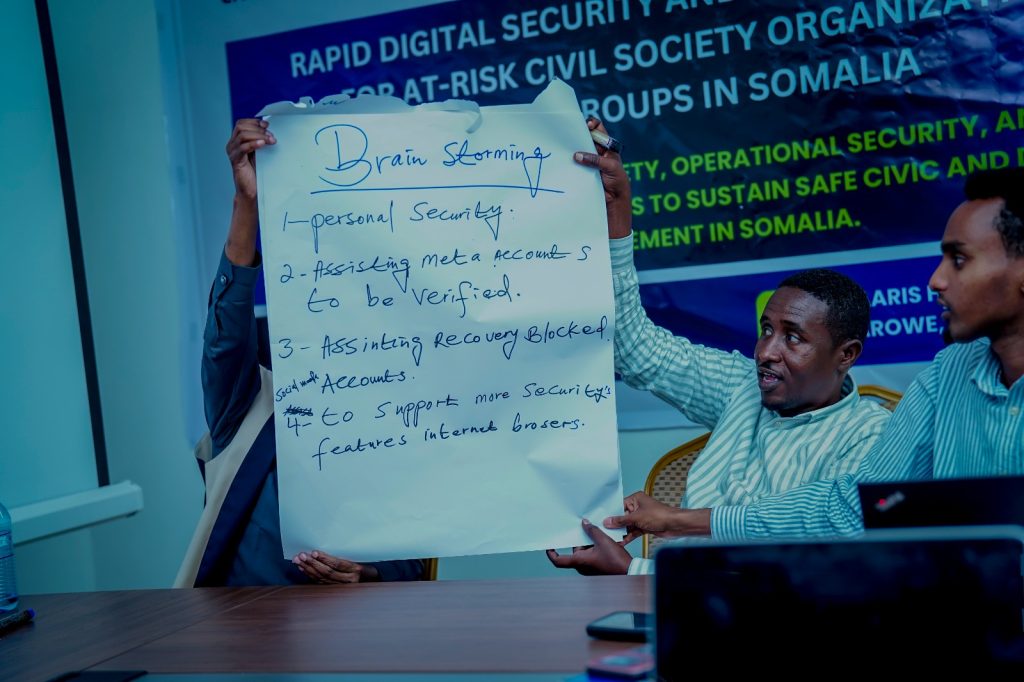
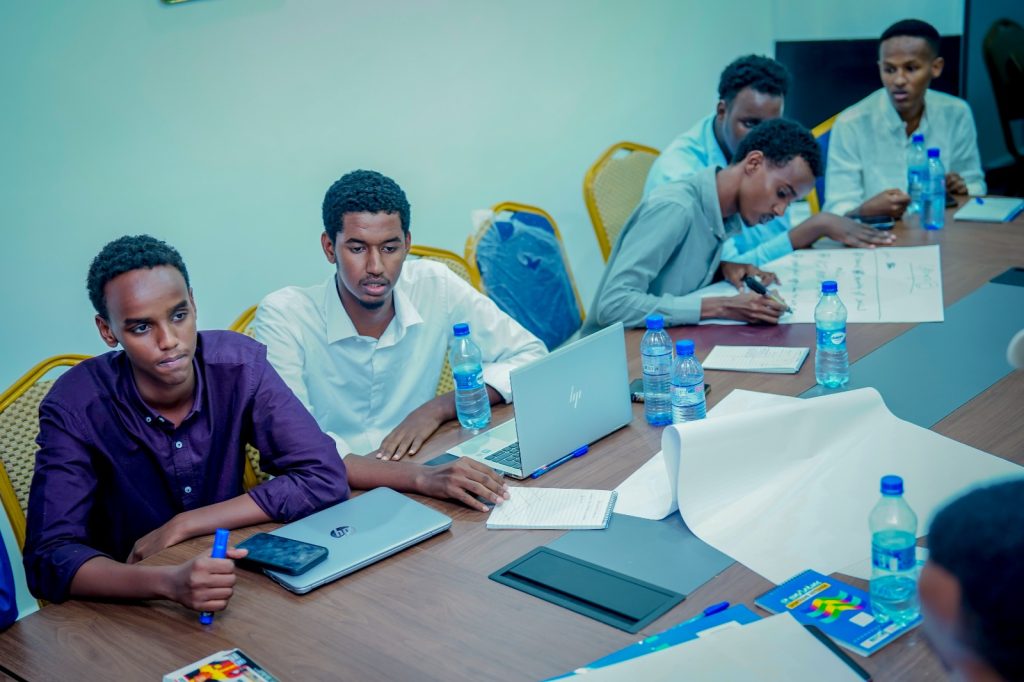
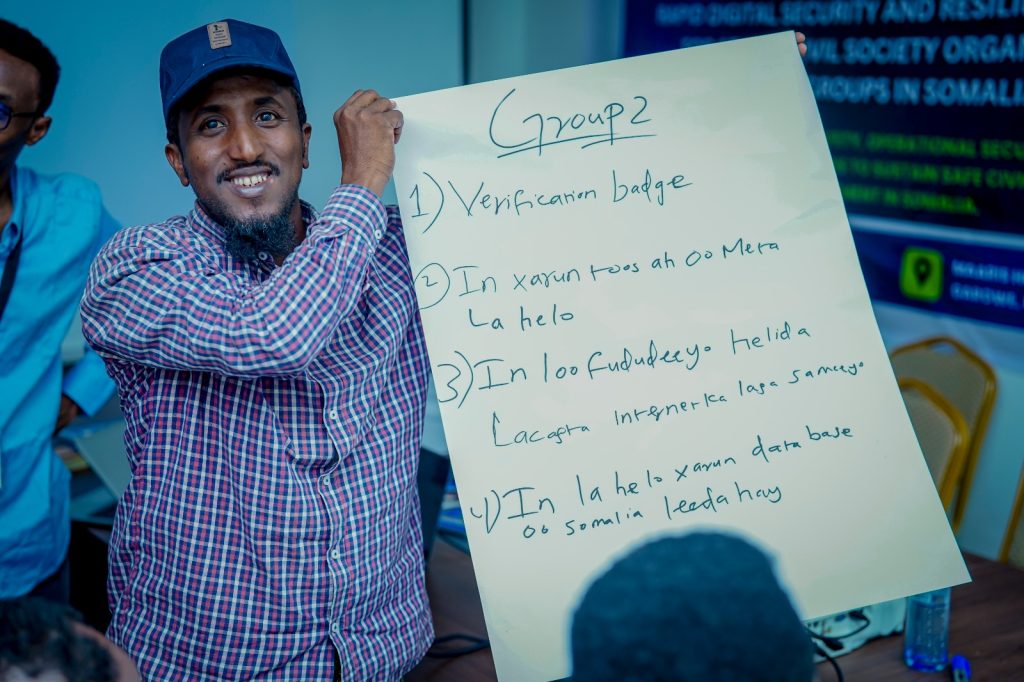
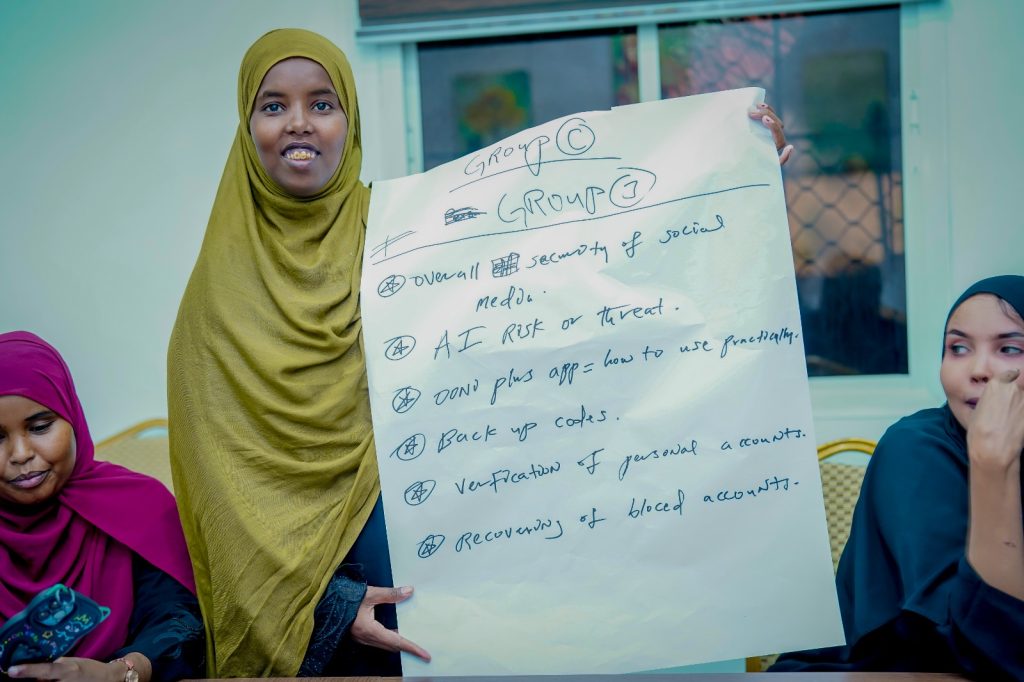
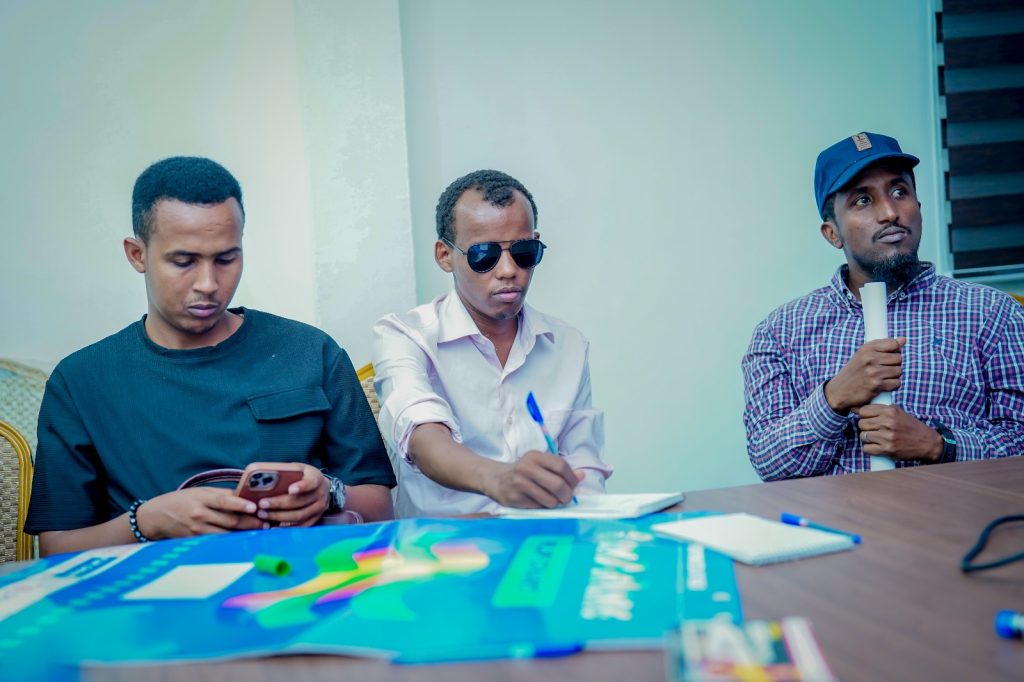
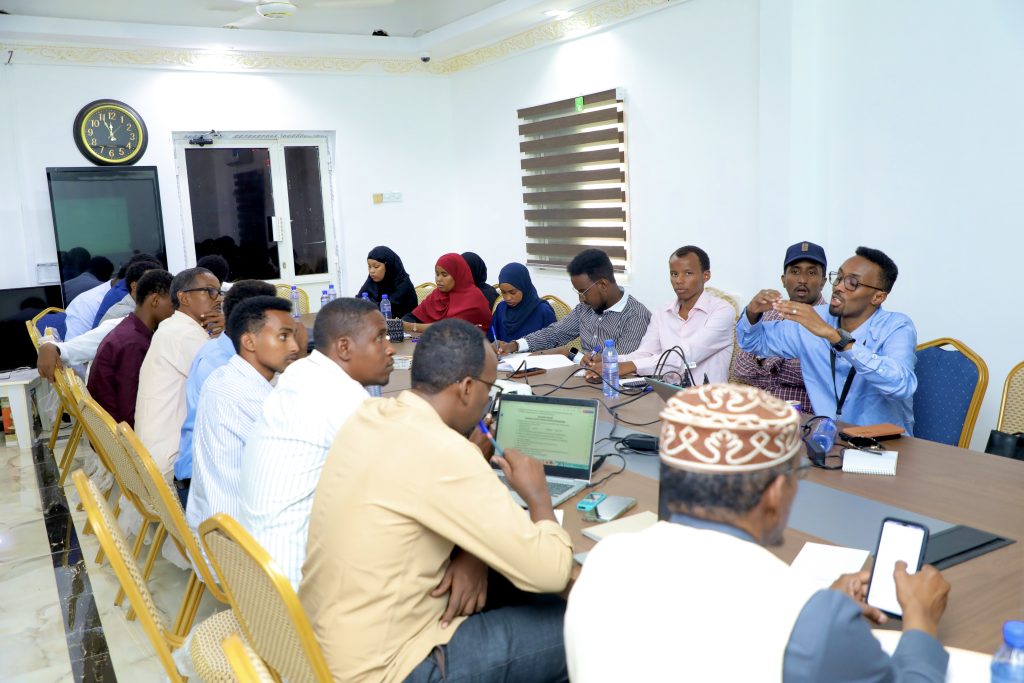
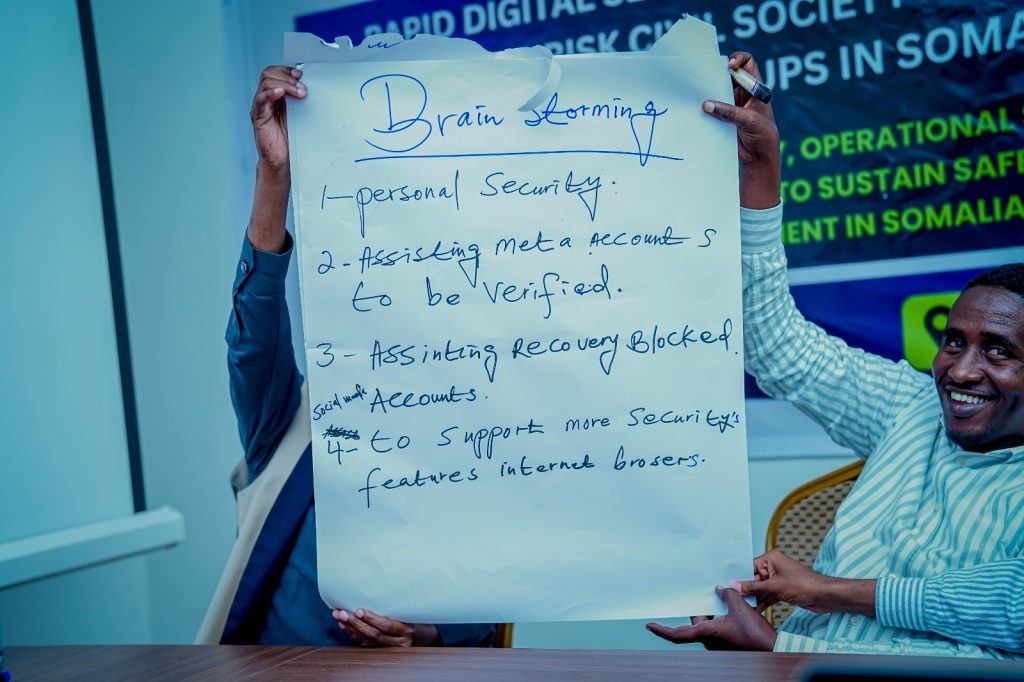
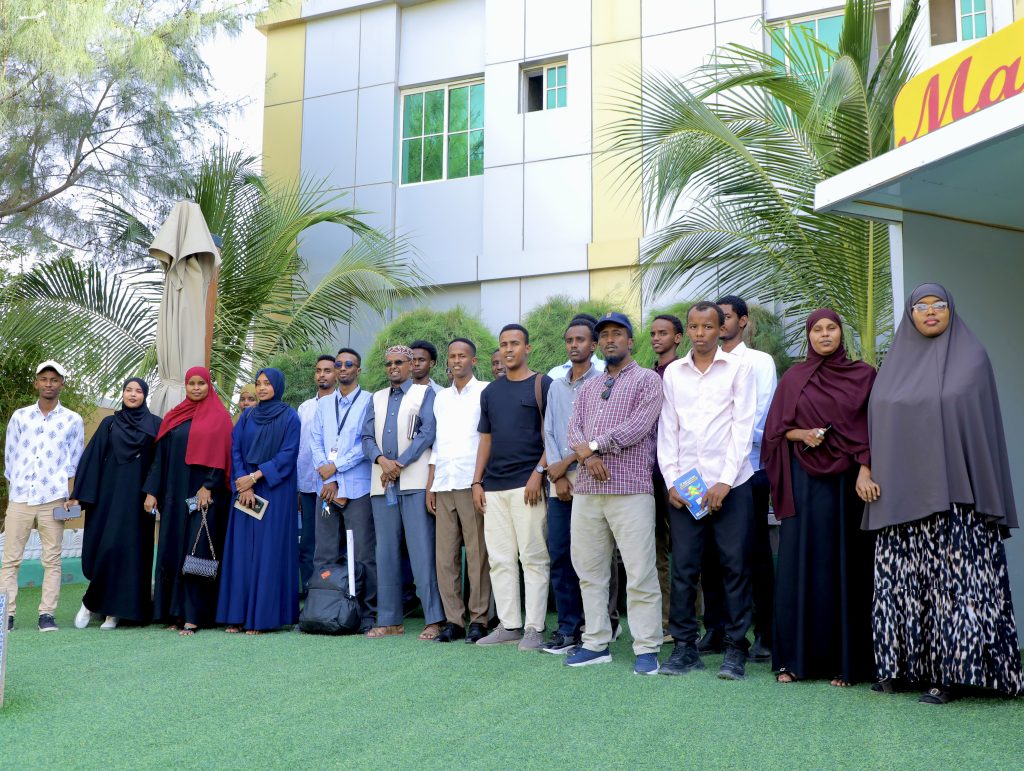
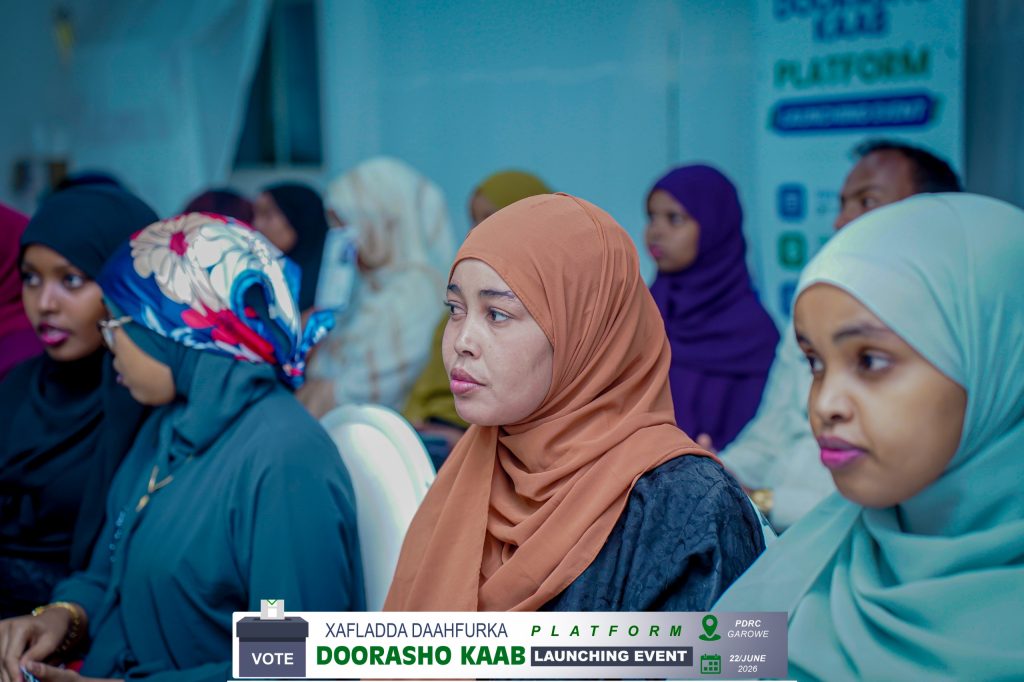
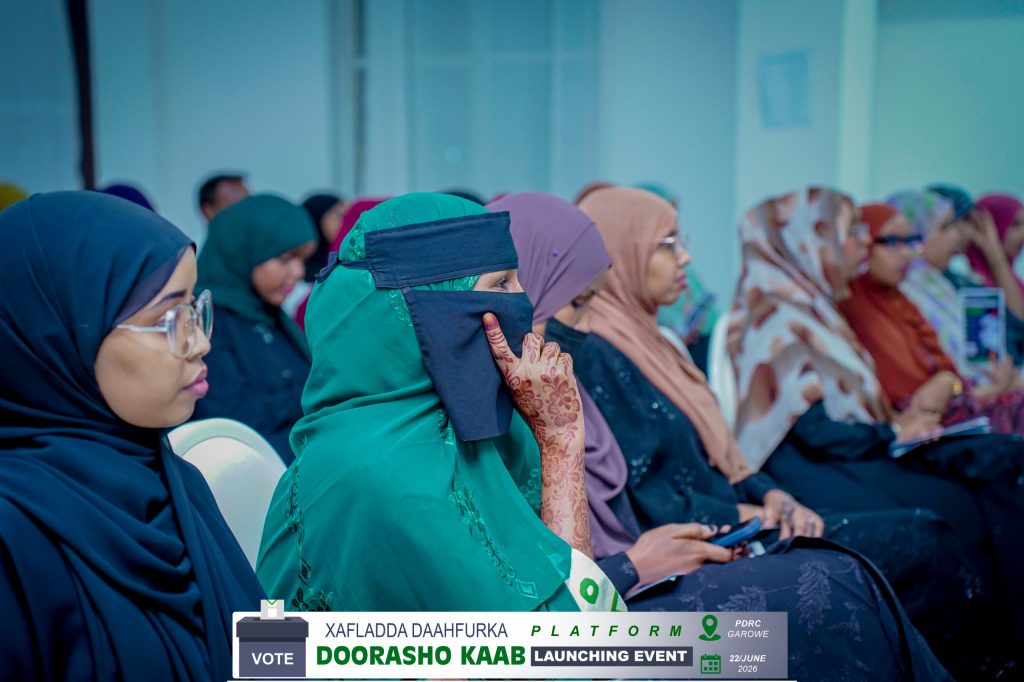
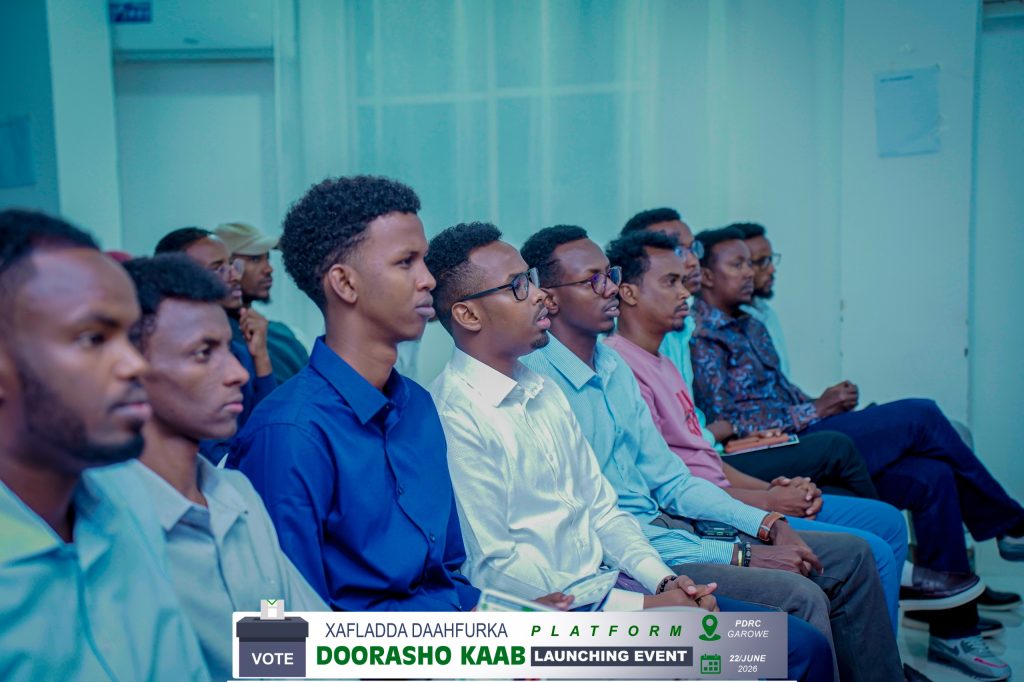
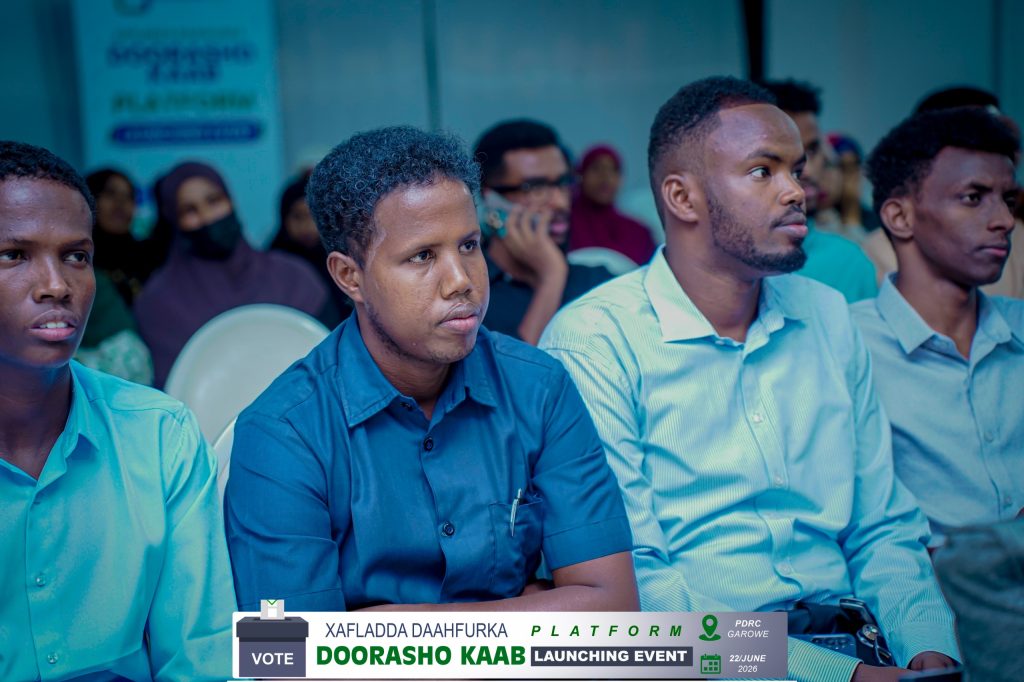
Bareedo Platform Somalia has concluded a Digital Security and Resilience Training in Garowe, Puntland, bringing together more than 35 participants from civil society organizations, women-led groups, youth movements, media organizations, and grassroots activist networks based in Puntland, Somalia.
The targeted rapid-response training aimed to strengthen participants’ digital safety, resilience, and operational security in response to growing risks such as hacking, online surveillance, cyber harassment, disinformation, and other digital threats that can disrupt the work of civil society and independent actors.
During the training, participants received practical guidance on securing social media accounts, protecting digital devices and online communications, strengthening data protection practices, identifying digital threats, and responding effectively to security incidents. The training contents was also included sessions focusing on wellbeing and healing digital trauma as results of digital threats to sustain civic activism.
The training forms part of Bareedo Platform Somalia’s broader efforts to support safer civic and democratic engagement across Somalia by strengthening the digital resilience of the civil society groups, human rights defenders, journalists and vulnerable rights groups working in challenging and high-risk environments.
Bareedo Platform Somalia continues to provide digital safety support, capacity-building, and emergency technical assistance to at-risk civil society organizations, activists, human rights defenders, journalists, women-led groups, and grassroots activists to sustain safe civic and democratic engagement across Somalia.
This initiative was made possible through the generous support of the CIVICUS Crisis Response Fund and the Digital Democracy Initiative (CRF-DDI), funded by the Danish Ministry of Foreign Affairs.
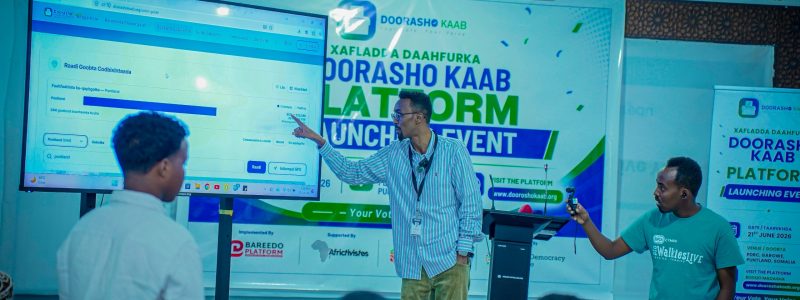
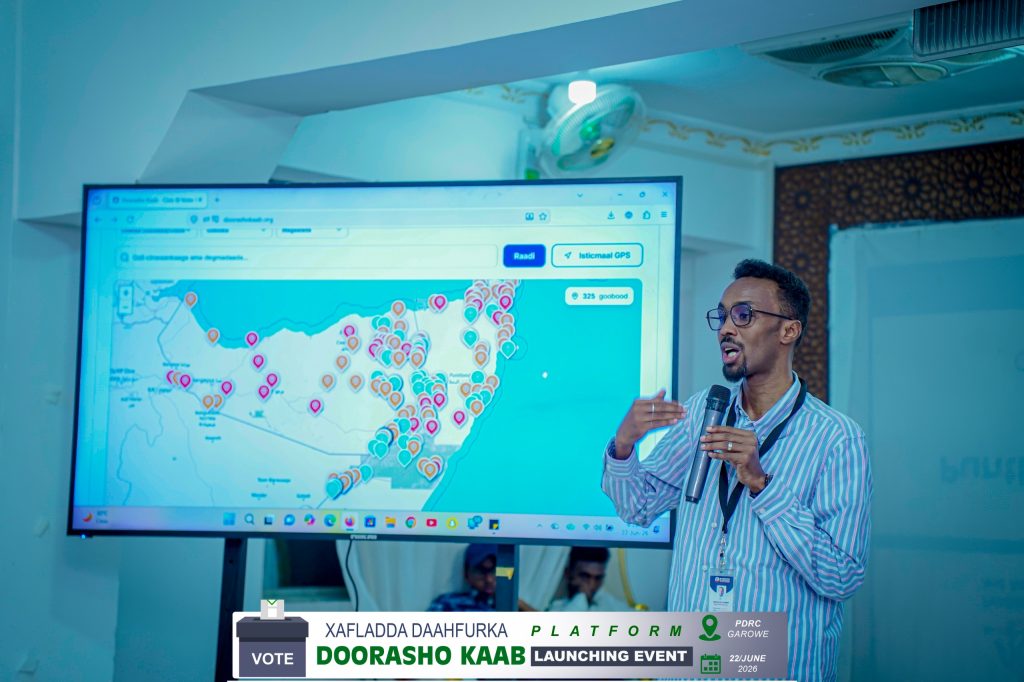
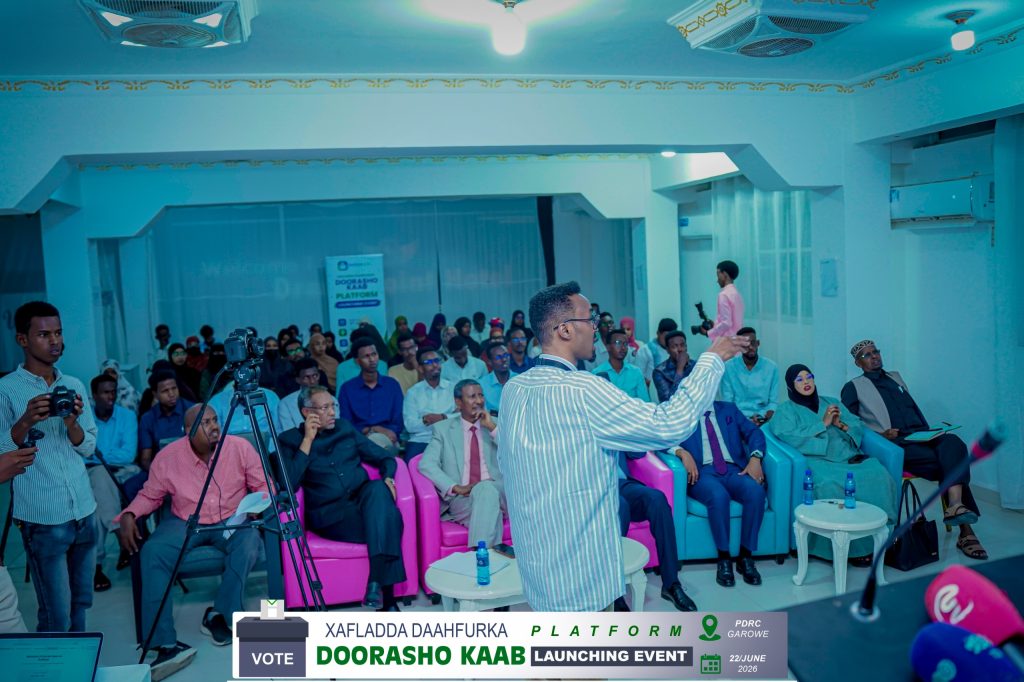
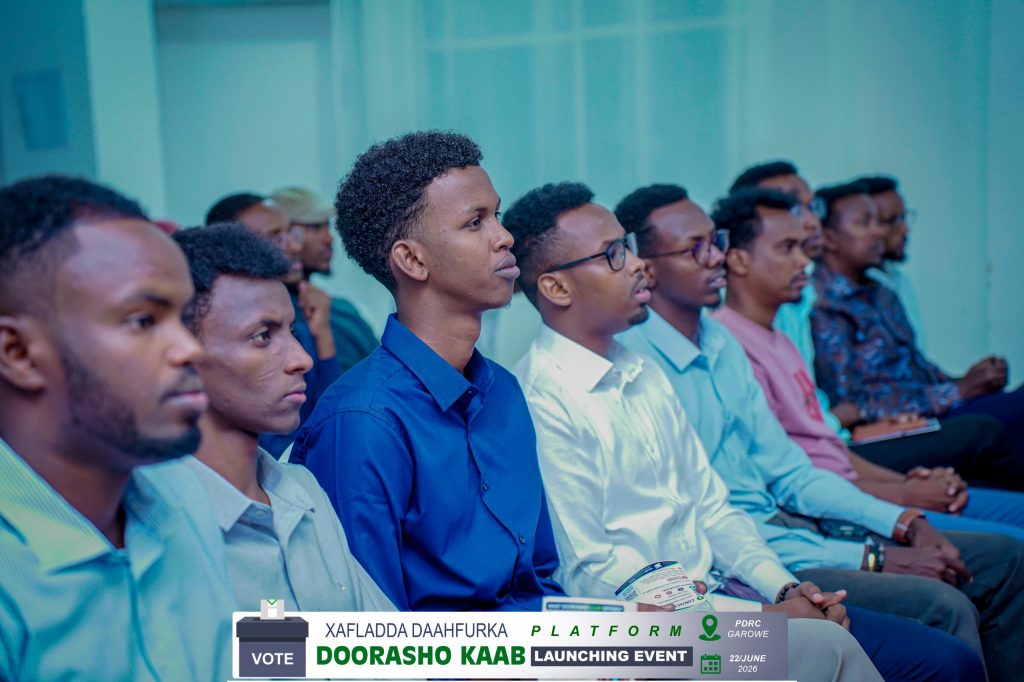
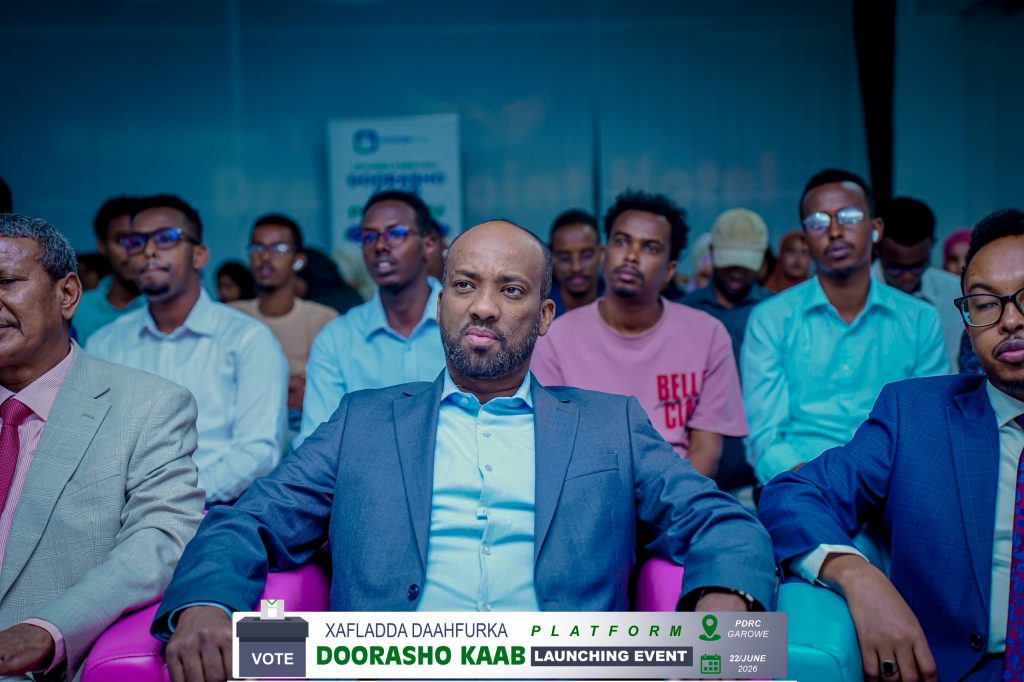
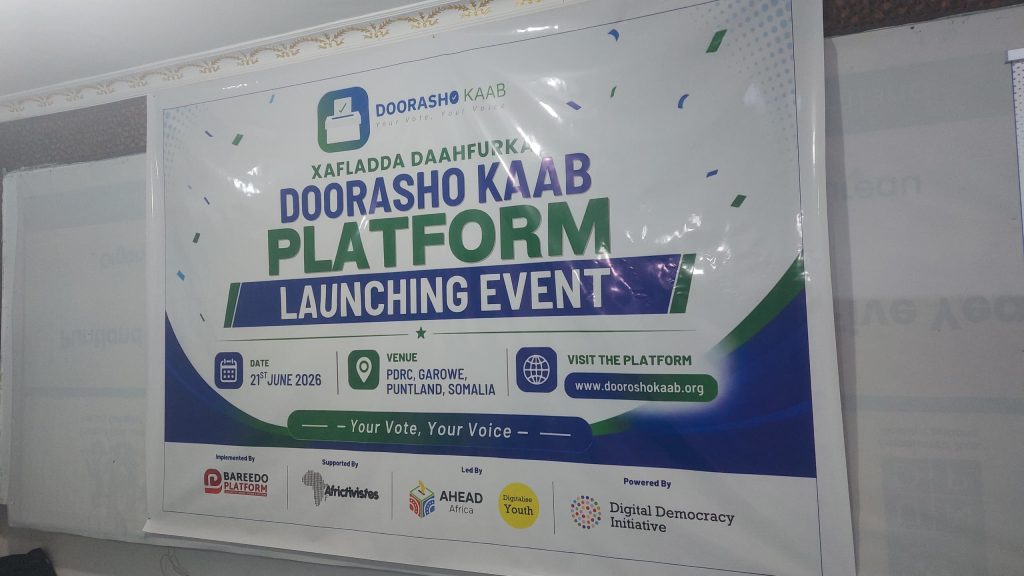
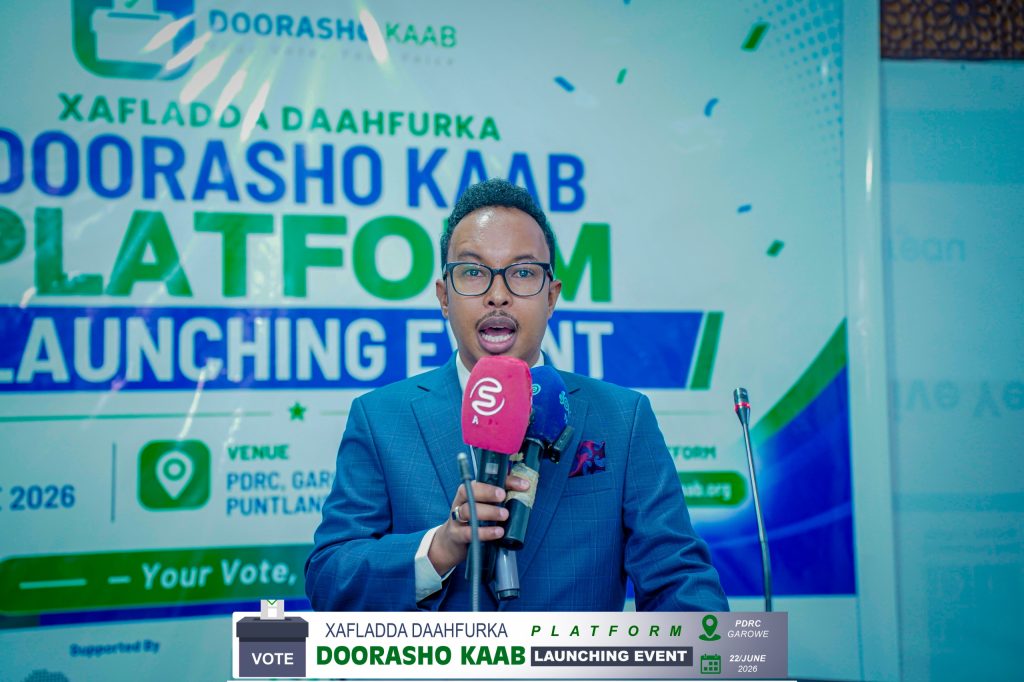
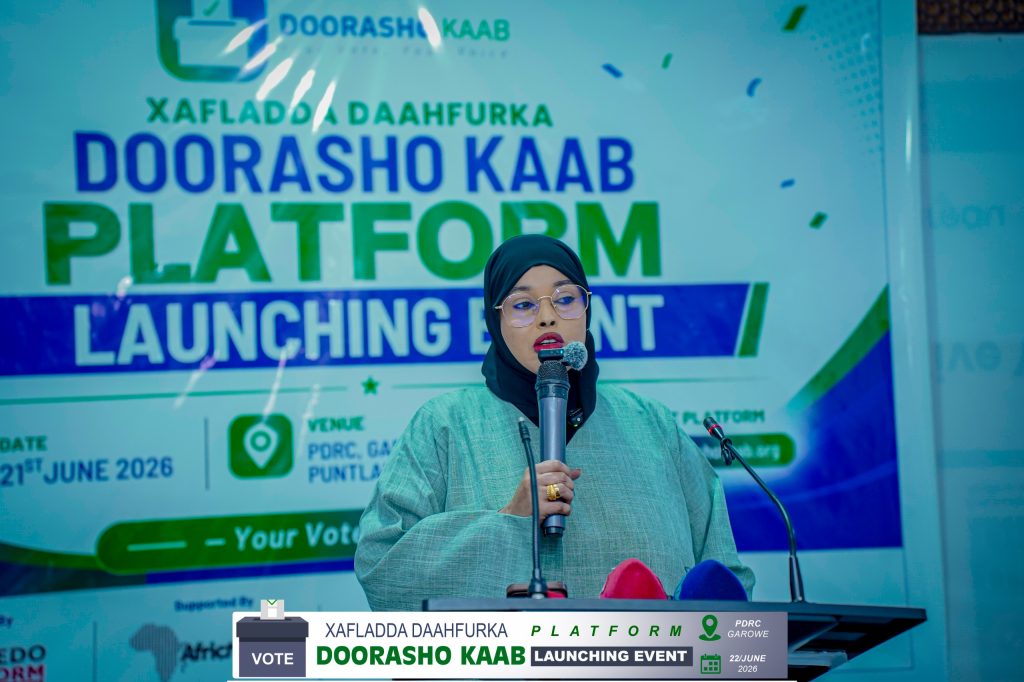
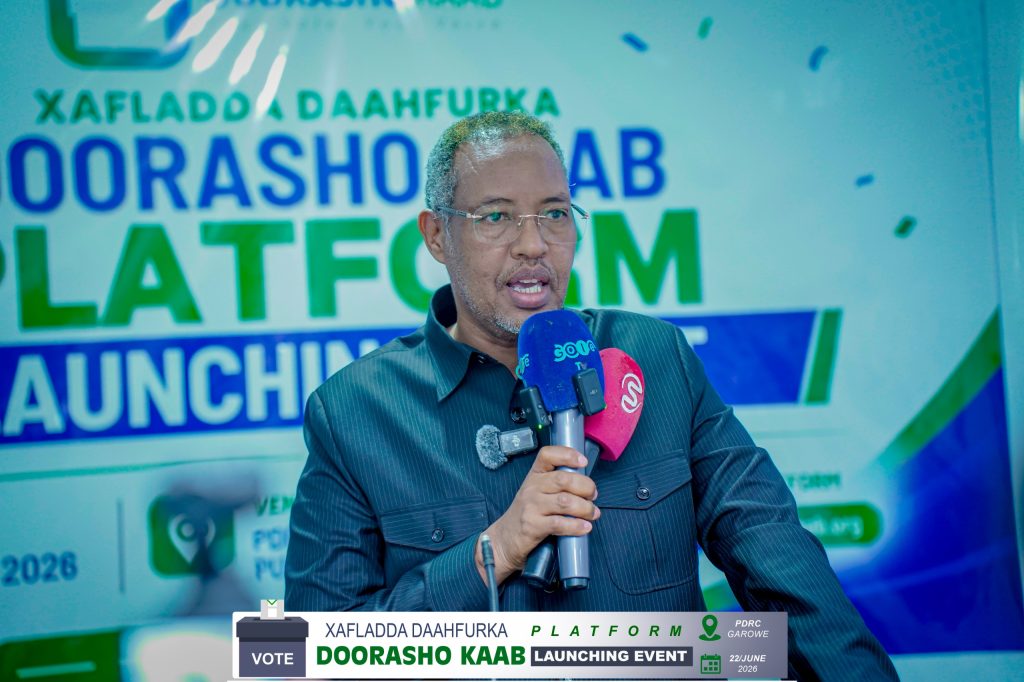
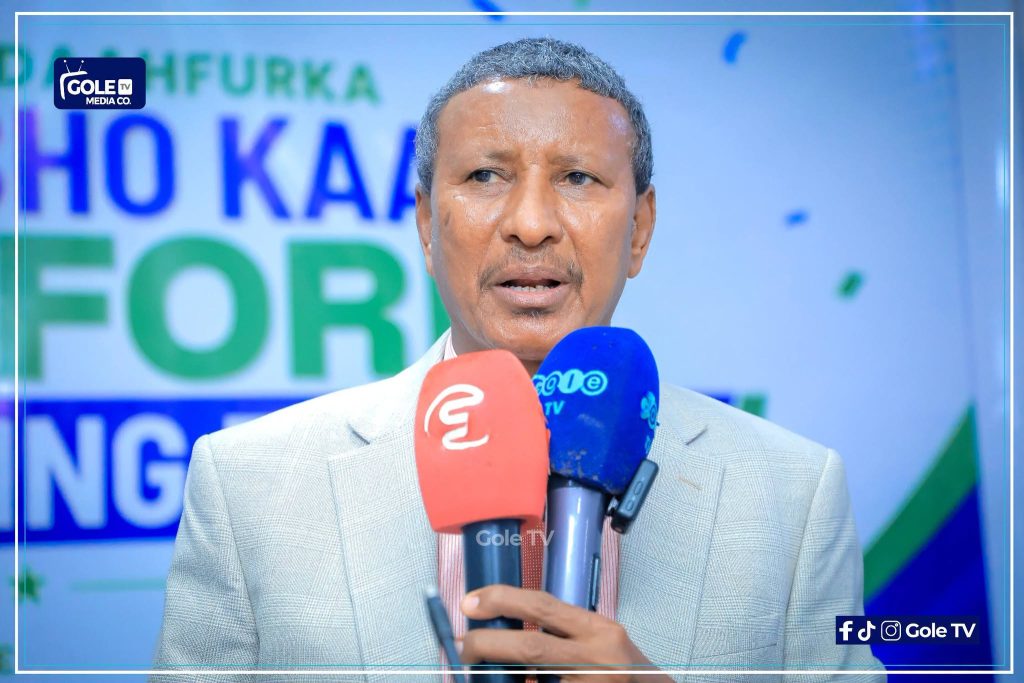
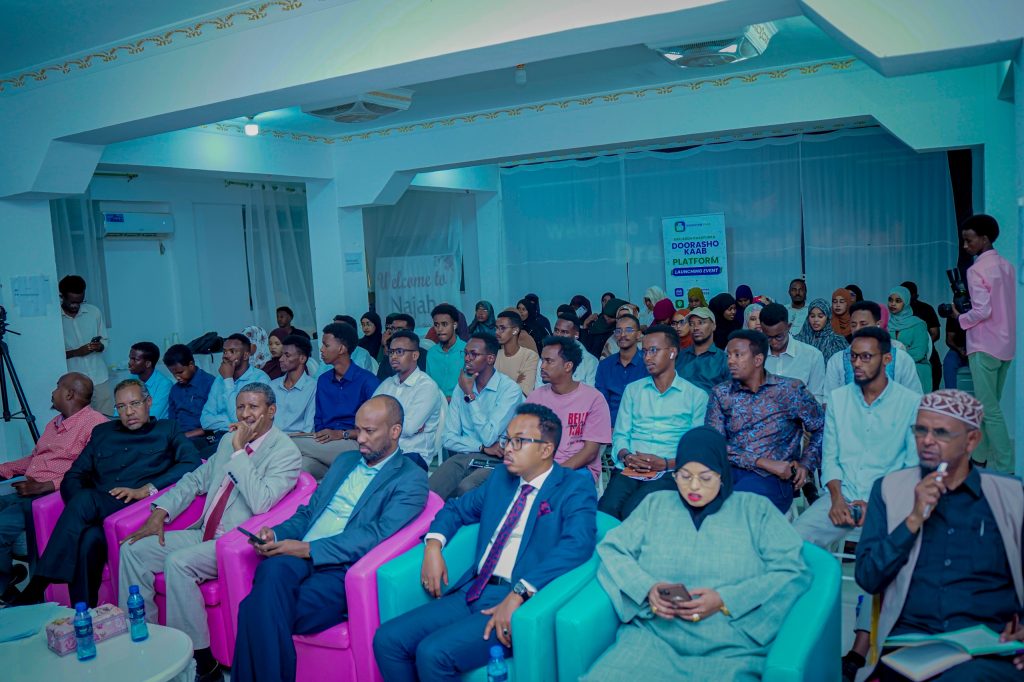
Garowe, Puntland – 22 June 2026 – Bareedo Platform Somalia, a youth-led civil society organization dedicated to promoting inclusive democracy and citizen participation, officially launched DoorashoKaab, an innovative civic technology platform designed to empower Somali citizens with accessible civic education, trusted voter information, and safe digital tools to learn, participate, and report during elections.
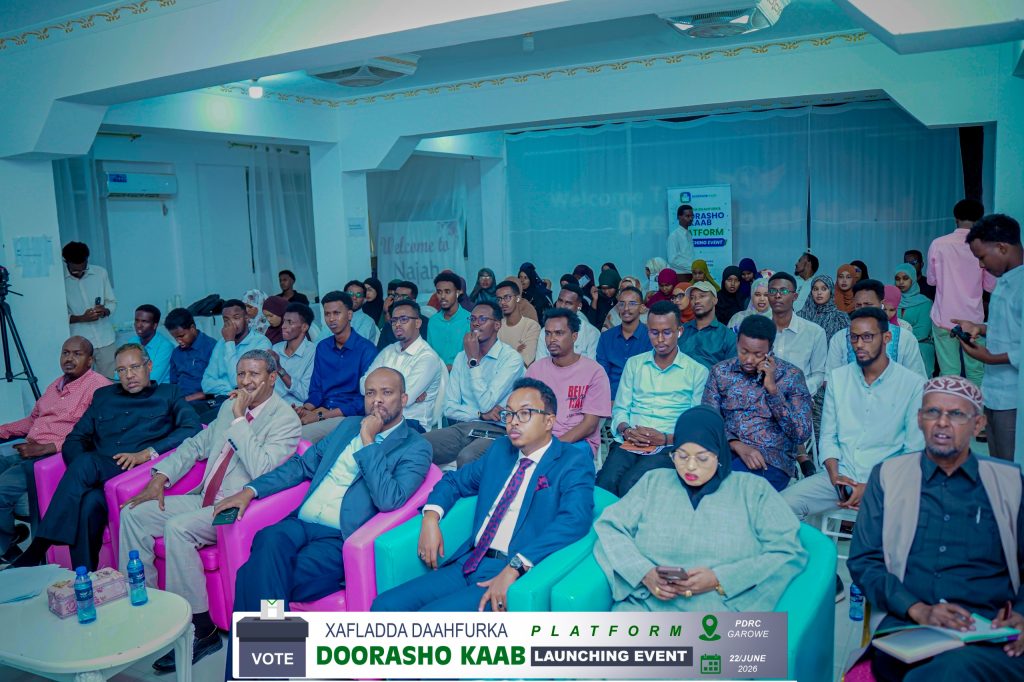
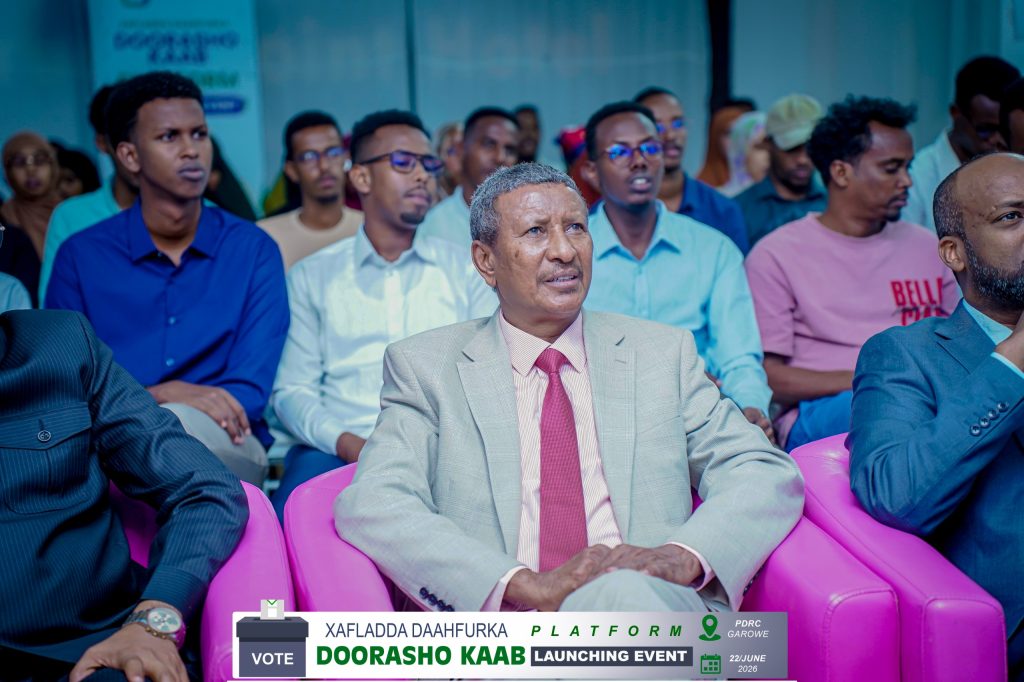
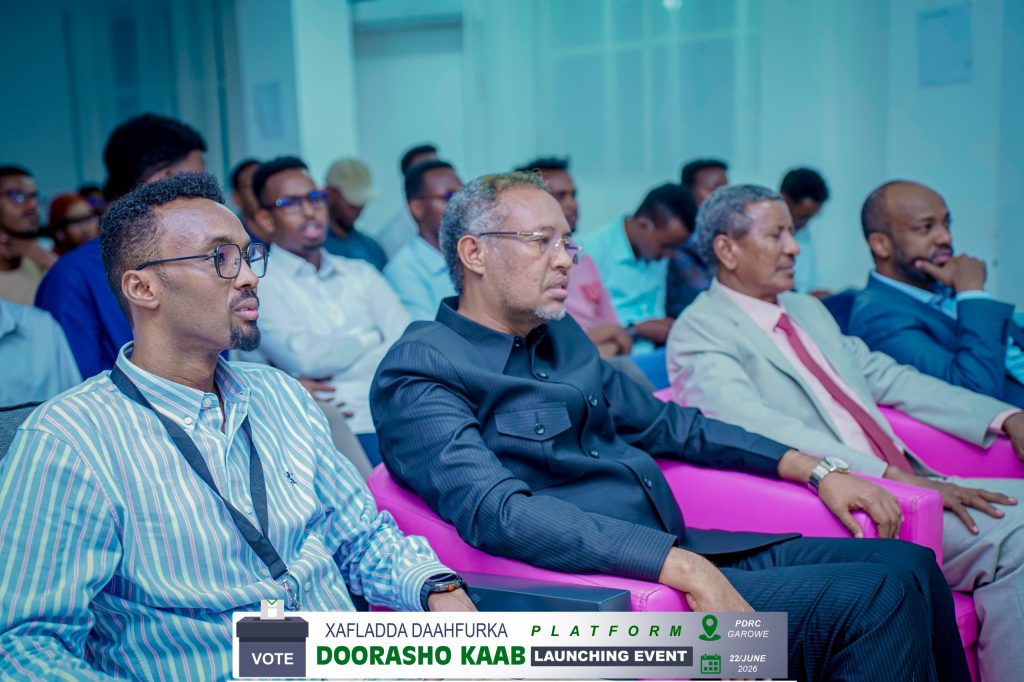
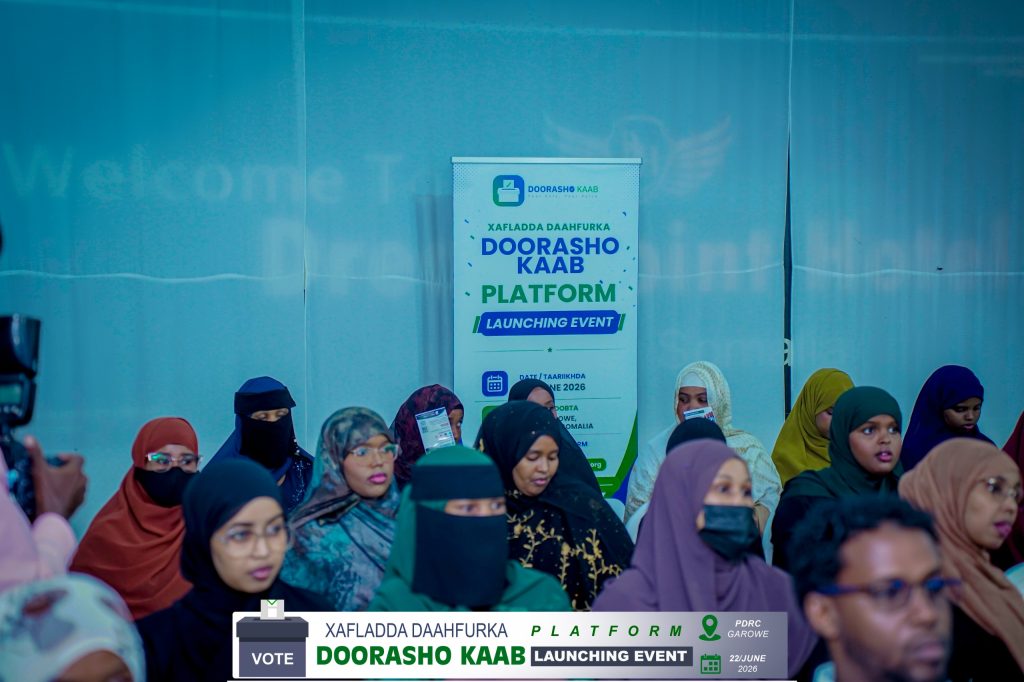
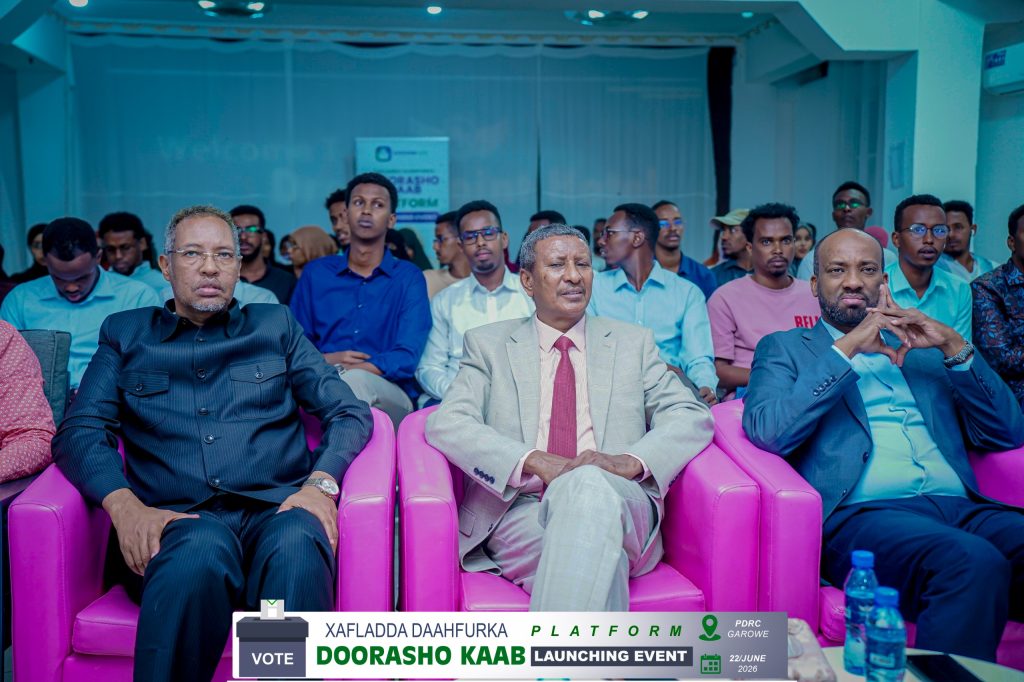
The official launch event was held at Dream Point Hotel in Garowe, Puntland, bringing together more than 50 representatives from government institutions, the electoral commission, political parties, civil society organizations, media outlets, youth networks, women-led organizations, and other key stakeholders committed to strengthening democratic governance in Somalia.
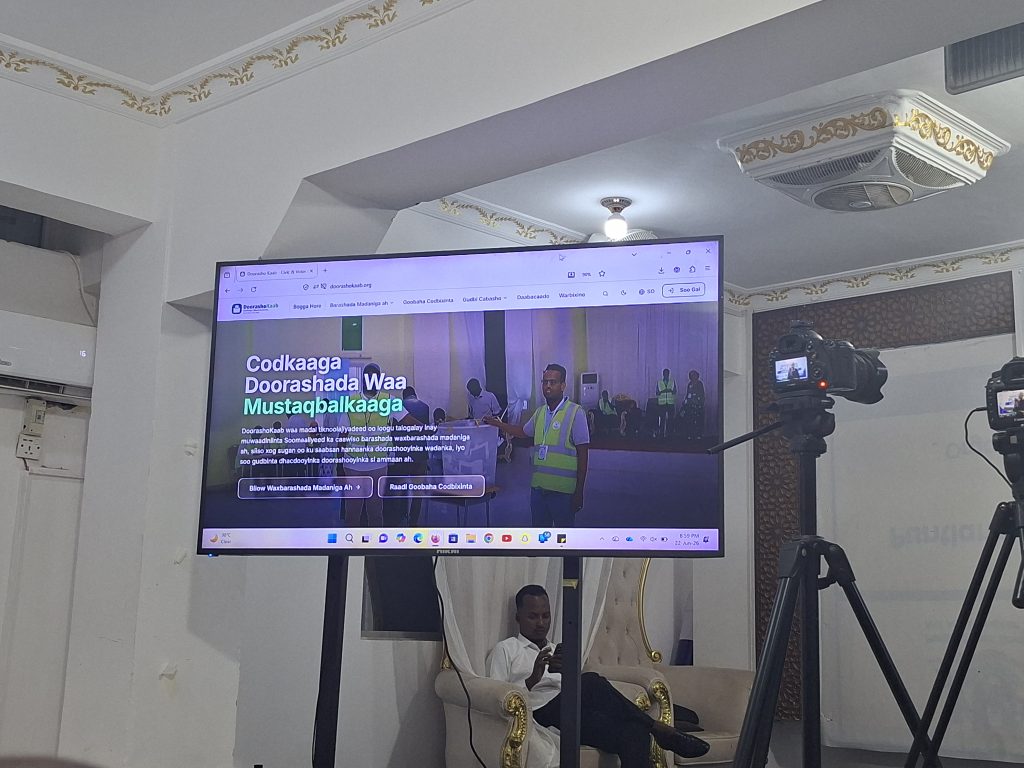
DoorashoKaab is a bilingual (Somali and English), open-source digital platform and mobile application developed by Bareedo Platform Somalia to address longstanding challenges in civic education, electoral participation, and transparency. Designed to operate effectively in low-bandwidth environments and accommodate varying levels of digital literacy, the platform provides accessible tools that enable citizens to participate more actively and confidently in democratic processes.
The platform was developed with support from the Election Civic Tech Fund of AfricTivistes, implemented through the AHEAD Africa and Digitalise Youth initiatives.
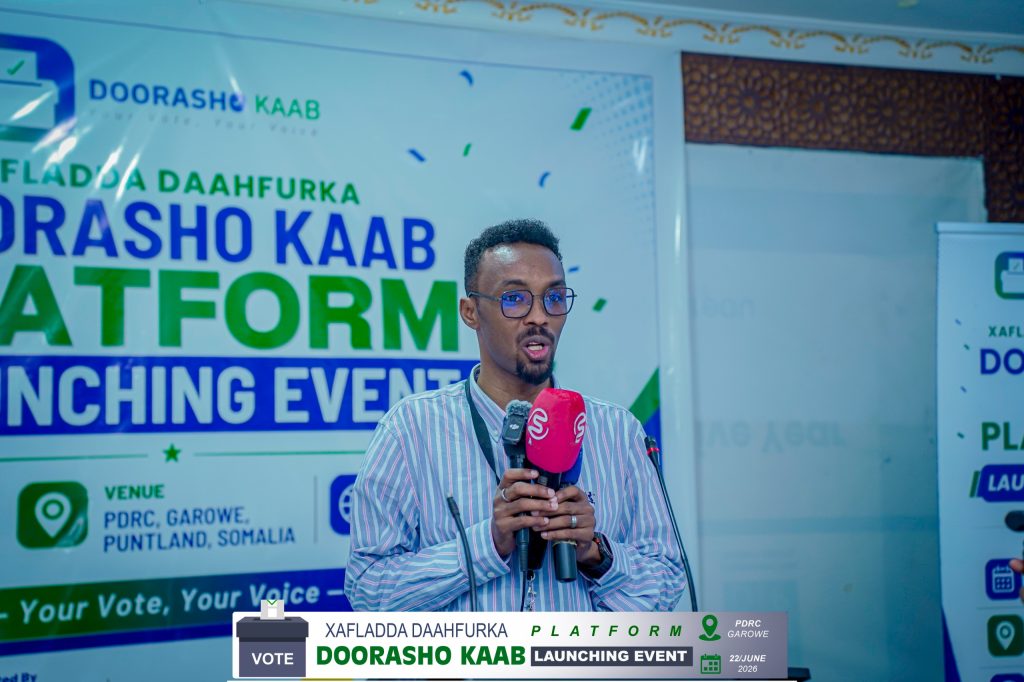
Speaking at the launch event, Abdikhayr Mohamed Hussein, Executive Director of Bareedo Platform Somalia, emphasized the need for innovative civic technology solutions in Somalia’s evolving democratic landscape.
“DoorashoKaab was developed in response to critical gaps in Somalia’s electoral ecosystem, particularly limited access to civic education, low and uneven participation among youth, women, and marginalized groups, declining public trust in electoral processes, and the increasing spread of misinformation. The platform also addresses the lack of safe and structured channels through which citizens can report electoral irregularities and engage meaningfully in democratic processes.”
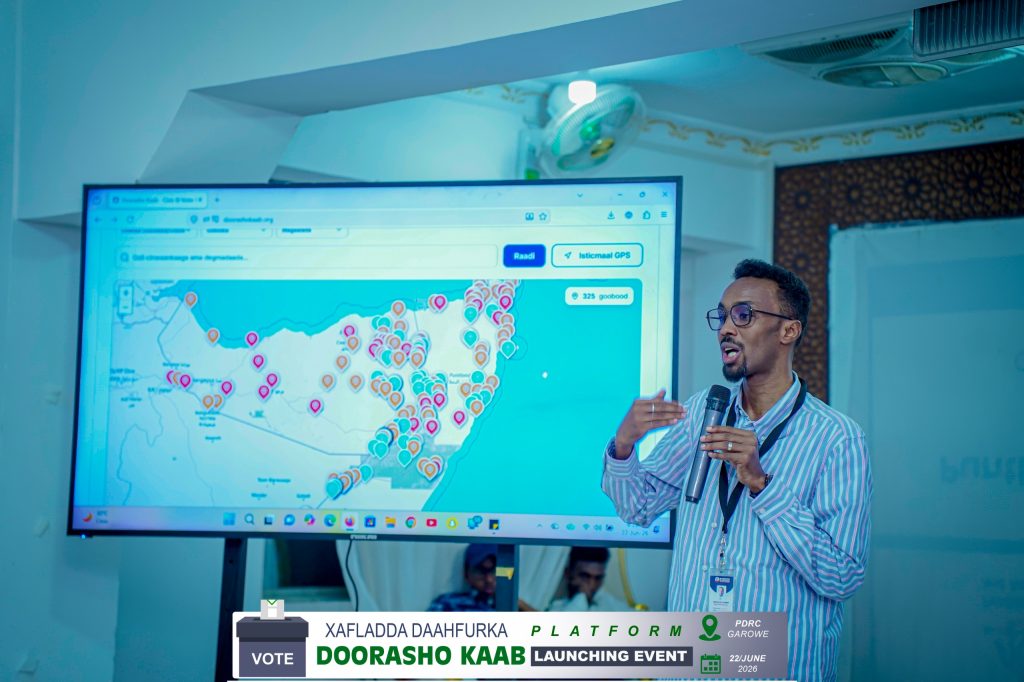
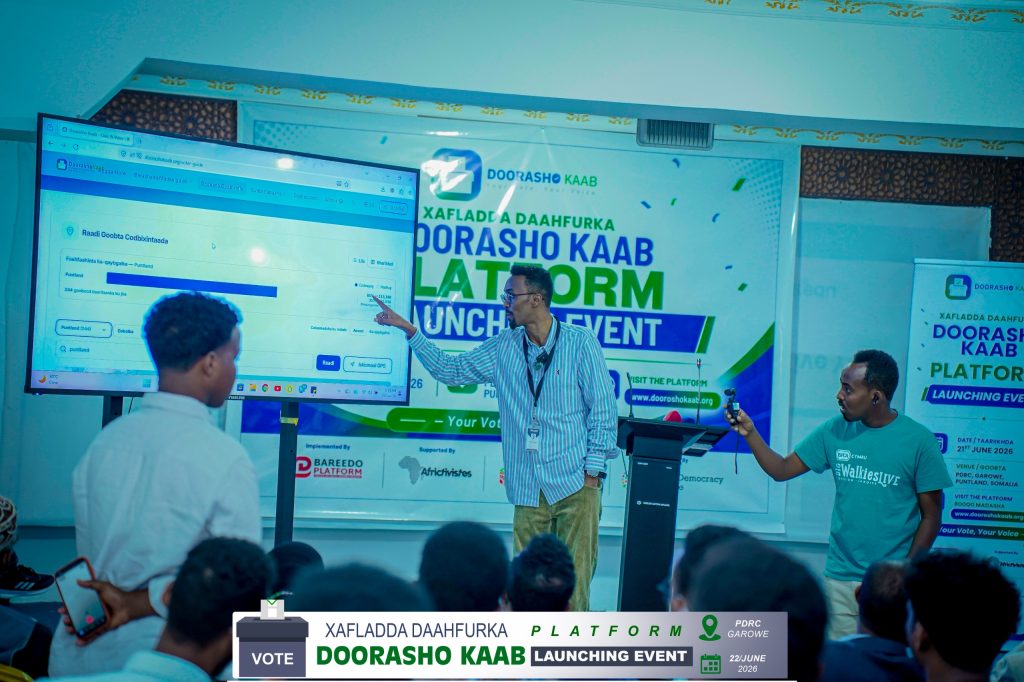
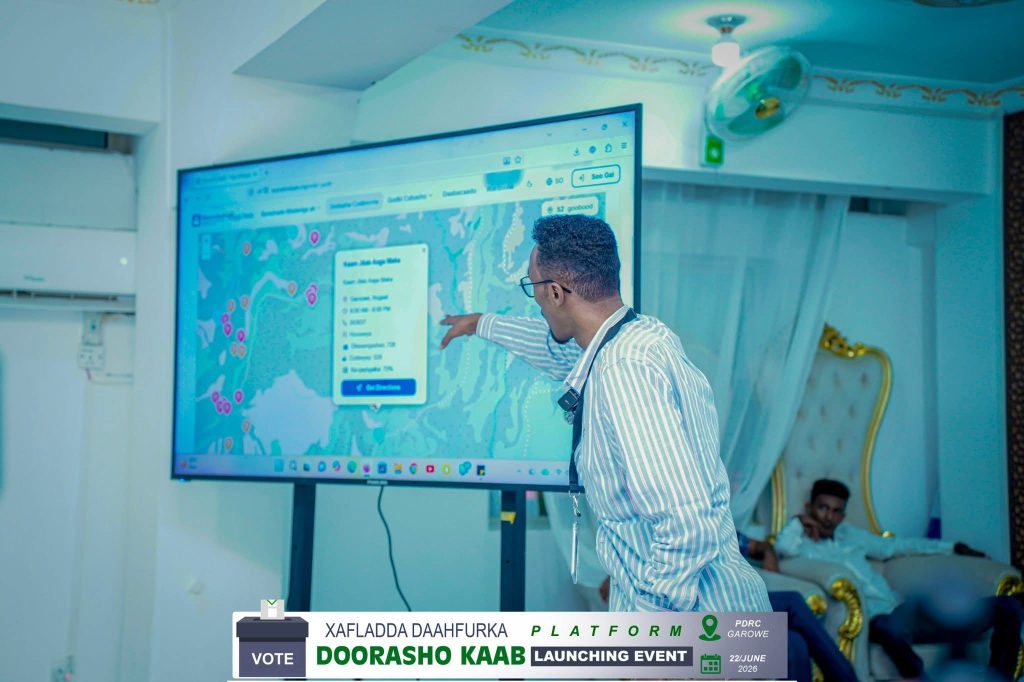
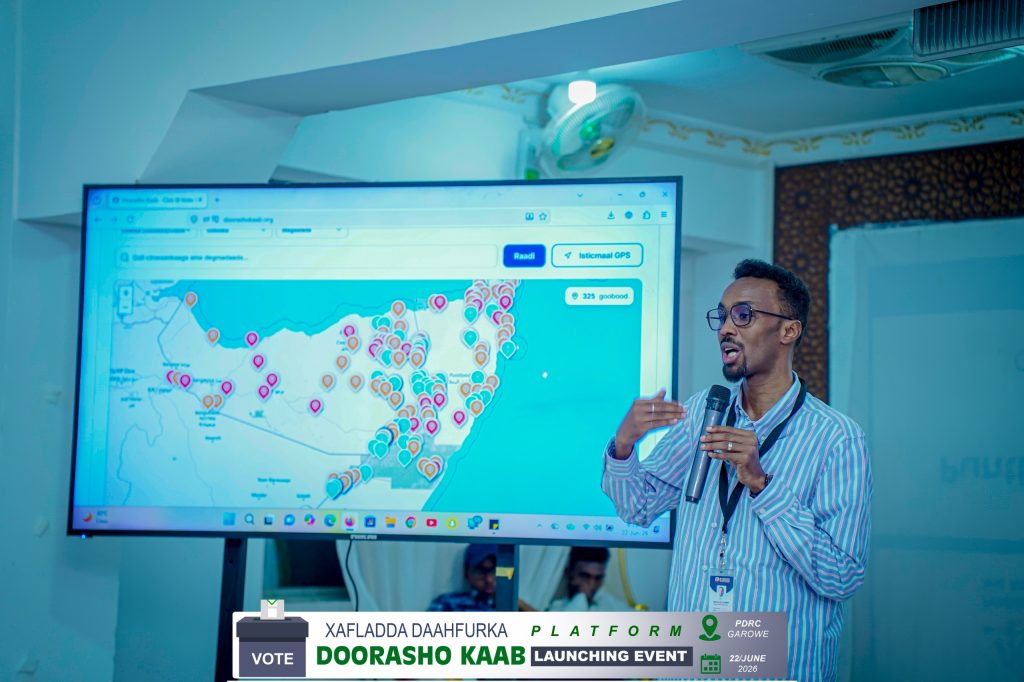
During the launch, Bareedo Platform presented the key features of DoorashoKaab, highlighting its role as a one-stop platform for civic learning, voter information, electoral transparency, and citizen engagement. The platforms consists of the following features:
Civic Education Section: The Civic Education Section provides a range of self-paced learning courses covering civic education, electoral processes, democratic participation, citizens’ rights and responsibilities, and safe electoral engagement. The platform also features a growing trained network of more than 150 Digital Civic Ambassadors based across Somalia who are leading grassroots civic education, voter awareness, and community engagement activities in their respective communities.
Polling Stations Section: The Polling Stations Section enables citizens to locate voting centers through interactive maps and searchable lists. It also provides information on registered voters, voter turnout, election schedules, polling locations, and verified election results. The platform presents election data and results from democratic elections held across Somalia in accessible visual formats.
Incident Reporting Section: The Incident Reporting Section allows citizens to safely report electoral concerns, irregularities, or incidents they witness before, during, and after elections. Users can submit reports through a simple digital form, attach supporting evidence, and receive a tracking number that enables them to follow the progress of their case while relevant authorities investigate and respond.
Resources Section: The Resources Section provides free access to election-related laws, policies, regulations, guidelines, procedures, and educational materials from the Federal Government of Somalia, Puntland, Somaliland, and other electoral institutions.
Updates Section: The Updates Section offers citizens access to verified election news, official announcements, reports, and real-time developments related to democratic processes across Somalia.
Stakeholders Welcome the Initiative
Following the presentation, participants commended Bareedo Platform Somalia for introducing an innovative tool that strengthens citizen participation and electoral transparency.
Ahmed Sahid, a youth representative from the Mustaqbal Political Party, praised the initiative and its potential impact on youth engagement.
“On behalf of young people and political parties, I commend Bareedo Platform for developing and launching DoorashoKaab. This is a timely and much-needed platform that will strengthen youth participation, democratic engagement, electoral transparency, and citizen involvement in Puntland and across Somalia.”
— Ahmed Sahid Youth Representative, Mustaqbal Political Party
Ifrah Abdinor, Executive Director of Midnimo Women Network, highlighted the platform’s potential to enhance women’s participation in elections.
“We warmly welcome this important initiative and see a significant opportunity for Somali women to participate more effectively and meaningfully in democratic and electoral processes.”
— Ifrah Abdinor Executive Director, Midnimo Women Network
H.E. Abdirahman Sheikh Ahmed, Puntland Minister of Labour and Social Affairs and member of Mideeye Political Party, expressed his appreciation for the platform’s extensive electoral information resources.
“I am impressed by the DoorashoKaab platform and appreciate Bareedo Platform for this remarkable initiative. The platform clearly demonstrates Puntland’s democratic progress, particularly through the availability of electoral laws, policies, and procedures, as well as information highlighting the strong voter turnout achieved in Puntland’s elections.”
— H.E. Abdirahman Sheikh Ahmed Minister of Labour and Social Affairs, Puntland
The platform was officially launched by H.E. Mohamud Aidid, Puntland Minister of Youth and Sports, who emphasized the importance of civic education in Somalia’s democratic transition.
“We highly appreciate this initiative and are particularly encouraged by the civic education component of the platform. Civic education is essential during this period of democratic transformation. I encourage young people to share DoorashoKaab widely within schools, universities, and youth networks so that more citizens can benefit from it.”
— H.E. Mohamud Aidid Minister of Youth and Sports, Puntland
Supporting Somalia’s Democratic Future
Bareedo Platform Somalia intends to continue expanding and strengthening DoorashoKaab so that citizens across all regions of Somalia can access civic learning resources, verified voter information, electoral updates, and safe reporting mechanisms through a single platform.
The organization believes that DoorashoKaab will contribute significantly to increasing the participation of youth, women, persons with disabilities, minority communities, and other underrepresented groups in democratic processes, while also promoting transparency, accountability, public trust, and informed citizen engagement.
As Somalia continues its democratic journey, civic technology initiatives such as DoorashoKaab offer new opportunities to connect citizens with democratic institutions and ensure that participation, transparency, and accountability remain at the center of electoral processes.
About Bareedo Platform Somalia
Bareedo Platform Somalia is a youth-led, non-profit organization established in 2015 to promote participatory democracy, civic engagement, open government, and digital rights in Somalia. Through innovation, technology, and citizen-centered approaches, the organization works to strengthen democratic governance and empower citizens to participate meaningfully in public affairs.
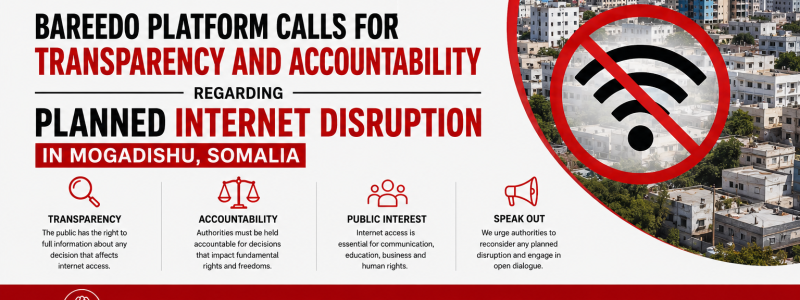
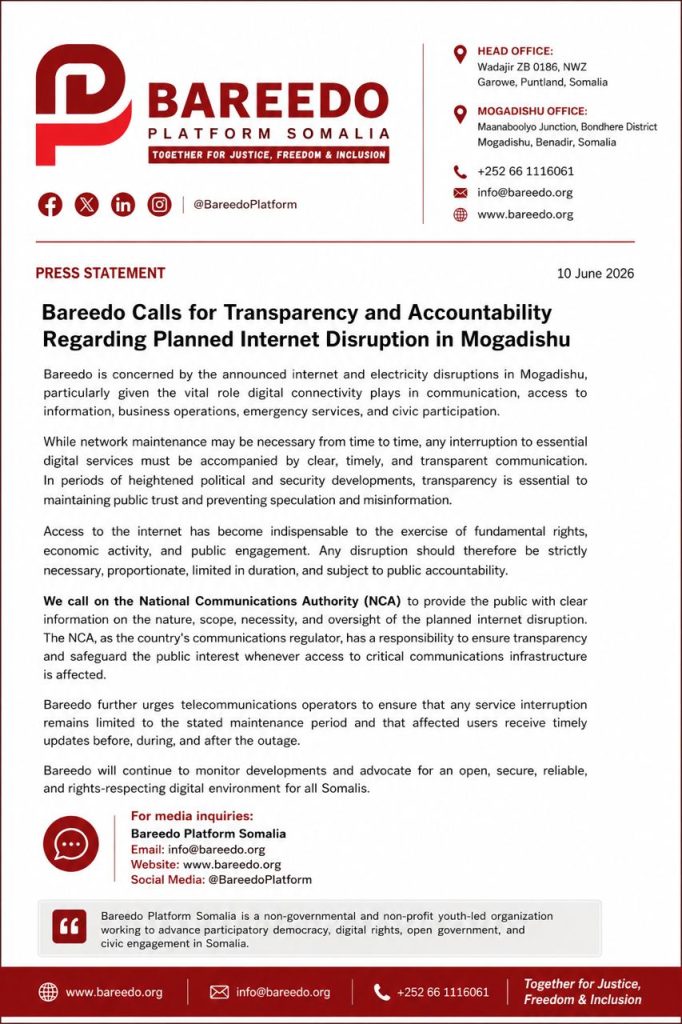
Bareedo Platform Somalia is concerned by the announced internet and electricity disruptions in Mogadishu, particularly given the vital role digital connectivity plays in communication, access to information, business operations, emergency services, and civic participation in Somalia.
While network maintenance may be necessary from time to time, any interruption to essential digital services must be accompanied by clear, timely, and transparent communication. In periods of heightened political and security developments, transparency is essential to maintaining public trust and preventing speculation and misinformation.
Access to the internet has become indispensable to the exercise of fundamental rights, economic activity, and public engagement in Somalia. Any disruption should therefore be strictly necessary, proportionate, limited in duration, and subject to public accountability.
We call on the National Communications Authority (NCA) to provide the public with clear information on the nature, scope, necessity, and oversight of the planned internet disruption. The NCA, as the country’s communications regulator, has a responsibility to ensure transparency and safeguard the public interest whenever access to critical communications infrastructure is affected.
Bareedo Platform Somalia will continue to monitor developments and advocate for an open, secure, reliable, and rights-respecting digital environment for all Somalis.
Bareedo Platform Somalia, with the support of the Digital Defenders Partnership (DDP), conducted a two-day training in Garowe, Puntland, Somalia, from June 27 to 29, 2024, for over 42 civil society organizations from various regions of Somalia. In this training, Bareedo Platform trained them on how they can use Microsoft technology, software, and products provided for nonprofit organizations after they have received approval from Microsoft to use these products free of charge. They received training on utilizing Microsoft-provided security tools, which aid in preventing cyber-attacks, detecting and resolving threats, and responding to data breaches.
Bareedo Platform previously identified and recognized 91 civil society organizations, predominantly led by women human rights defenders, feminists, and minorities, as the most vulnerable to digital attacks and threats in Somalia. These groups have consistently faced severe digital attacks such as phishing, spyware, communication theft, surveillance, privacy breaches, censorship, and online harassment, which have significantly impacted their work. Their vulnerabilities mainly resulted from their lack of digital security knowledge and their use of insecure digital equipment and communication platforms, which made them more vulnerable to digital attacks.
Before this training, Bareedo Platform had been providing individual technical assistance for these civil society organizations for months to develop sustainable internal digital security policies and action plans to better respond to cybersecurity challenges and digital threats. The support included how these organizations could have access to Microsoft’s grants, donations, and discounted products and services specifically designed for nonprofit organizations, although these organizations could not afford to buy the expensive secure software and products.
With the technical assistance of Bareedo Platform, 40 out of 51 organizations that applied for Microsoft Nonprofit Solutions received approval from Microsoft to use their secure software and products free of charge or at a discounted price. Bareedo Platform conducted a two-day training for these organizations to teach them how to use the services provided by the Microsoft nonprofit to help them effectively protect themselves from digital threats.
With the use of Microsoft’s secure products and software, these civil society organizations, which have previously faced digital threats and attacks, can now keep their data safe from cyberattacks and help manage their network security.
As part of this project that is funded by Digital Defenders Partnership (DDP), Bareedo Platform previously conducted three-days long digital security awareness and training for 108 civil society organizations, human rights defenders, activists, and journalists in Somalia who have been facing digital attacks and risks. The training which was held from March 2, 2024 to March 4, 2024 in Garowe, Somalia and facilitated by a professional digital security expert, the participants learned the following digital knowledge and practices to respond to the digital security challenges they face in their work and daily lives.
Bareedo Platform also reached out to and provided direct digital security support for 49 NGO staff, human rights defenders, activists, and journalists across Somalia and also helped 21 civil society organizations, particularly those led by vulnerable groups such as women, feminists, minorities, and LGBTQ people, solve some immediate security threats and risks they have been facing digital threats throughout Somalia, as well as develop sustainable internal digital security policies and action plans to better respond to cybersecurity challenges and digital threats.
Bareedo Platform also developed the first draft of a digital risk assessment tool that will be available online for more than 10,000 civil society organizations, human rights defenders, activists, and journalists in Somalia to identify their online security strengths and weaknesses and get relevant recommendations and resources for improvement.
Bareedo Platform appreciates Puntland NGO Network (PUNTNGO), an umbrella body that brings together all registered local non-governmental and non-profit organizations (NGO) operating in Puntland, Somalia, for facilitation of the training, as well as their close collaboration on referral and bringing the most at-risk groups facing digital attacks to our attention.
With the support of the Digital Defenders Partnership (DDP), Bareedo Platform Somalia held a three-day digital security training for more than 70 civil society organizations, human rights defenders, activists and journalists from all regions of the state of Puntland in Somalia to promote their digital security capacity to better respond to cybersecurity challenges and digital threats.
The training included and gave priority to the organizations run by the most vulnerable groups, such as women journalists, women human rights defenders, women activists, feminists, minorities, and people with disabilities who are subject to digital attacks or at risk of digital threats. 93% of the training participants have never had or participated in digital security training. 79% of them have been facing cybersecurity challenges and digital threats. The Puntland NGO Network (PUNTNGO), an umbrella organization that brings together all registered local non-governmental and non-profit organizations (NGO) operating in Puntland, Somalia, facilitated the identification, selection, and reach of these organizations and human rights defenders.
The training was held between March 2, 2024, and March 4, 2024, and was held in Garowe at the conference hall of Puntland State University, which is an ample and perfect venue for accommodating a large number of participants in observance of the COVID-19 health and safety measures.
Professional digital security experts with extensive knowledge and experience in cybersecurity facilitated and led the training. They taught the training participants topics covering knowledge and practical experience on how to deal with different digital risks, including phishing, ransomware, malware, password protection, information security, social engineering, physical security, mobile device security, email security, working remotely, cloud security, social media, safe web browsing, risk management, and incident reporting. Updates about the newly-emerged threats and vulnerabilities that civil society organizations and human rights defenders need to be aware of and watchful of. The training also included sessions covering how these organizations develop sustainable internal digital security policies and action plans to better respond to cybersecurity challenges and digital threats.
The training was participatory and highly practical, where the participants engaged in discussions, brainstorming, and experience-sharing sessions where they talked about the risks and problems they face online, such as cyber-harassment, trolling, doxing, non-consensual image distribution, and others, as well as the solutions and how to respond to them and ensure their digital safety in the long run.
Bareedo Platform ensured the relevance and appropriateness of training lessons and knowledge that fit the needs of the participants based on previous incidents, vulnerabilities, and risks they face online. The training materials were developed in line with the needs of the target population and the findings of a digital security assessment survey that was conducted before the training.
95% of the training participants reported that the training was helpful for them and that the training contents were relevant and most appropriate to their digital security needs in a post-training survey conducted after the training.
As a result, the training adequately improved the capacity and resilience of these 70 civil society organizations and human rights defenders, who have been facing severe cybersecurity challenges and digital threats. In consideration of pre-training and post-training surveys, the participants improved their digital security capacity and resilience and tapped practical knowledge and capacity to respond to the digital security challenges they face in their work and daily lives. The training participants rated their digital security knowledge as 7.3% “excellent,”, 52.5% “good,”, and 8.5% “adequate” in a post-training survey conducted after the training.
The training participants also learned and practiced how they can develop their own digital safety policies and plans customized to their needs and goals and adopt basic safety practices, such as incorporating digital security training into their onboarding process for new staff and encouraging interest in digital safety practices among all staff.
88.1% of the training participants said that the training met their expectations in a post-training survey conducted after the training. As part of the participants’ action plans after the training, 55% of them said they will train and share what they have learned with their organization’s staff members; 29% said they will help their organizations conduct digital risk assessments to identify online security strengths and weaknesses as well as develop applicable recommendations and resources for improvement. 15.3% said they will help their organizations develop long-term internal digital security policies and action plans to better address cybersecurity concerns and digital threats.
This much-needed training is part of the activities of a project entitled “Strengthening the digital security capacity of civil society organizations, human rights defenders, activists, and journalists in Somalia” implemented by Bareedo Platform in Somalia in response to the growing digital security threats and attacks faced by civil society organizations, journalists, human rights defenders, and activists in Somalia.
The project was proposed after seeing that civil society organizations, human rights defenders, activists, and journalists have become more dependent on the internet and digital platforms than before for communications, organization, and the amplification of their critical work as Internet connectivity gains momentum in Somalia. Civil society organizations, human rights defenders, activists, and journalists face a multitude of challenges and vulnerabilities in the online world, ranging from trolling, doxing, hacking, targeted surveillance, online harassment, smear campaigns, and disinformation, including gendered disinformation. These have chilling consequences, with most reporting the loss of their social media platforms, emails, and sensitive data. Some opt to self-censor, limit, or leave online spaces, and activism works.
These challenges continued to exist because these groups lacked the knowledge and capacity to defend against online threats, minimize their risks, and stay safe online, expressing feelings of helplessness when faced with things like surveillance and online harassment. Others have low awareness of actual threats and attacks, creating an “it won’t happen to me” attitude. Data shows that 72% of them have never participated in any digital security training that taught them how to use the internet or digital devices securely and how to protect their digital devices and platforms. Another challenge is that 79% of civil society organizations often do not have sufficient cybersecurity plans in place due to a lack of the necessary resources and expertise and the budget to hire outside security experts, leaving them vulnerable to breaches.
Bareedo Platform will continue to support and build the digital security capacity of civil society organizations, particularly those led by vulnerable groups such as women, feminists, minorities, and disabled people who are facing digital threats and risks throughout Somalia. Bareedo Platform will consider and prioritize the unique digital attacks and threats that these groups face on digital platforms and will develop the relevant digital tools and practices that they can adapt to ensure their digital safety in the long run.
In follow-up to the training, Bareedo Platform will use its digital security expert to offer virtual-based, one-on-one direct technical support for civil society organizations, including digital safety diagnostics, technical assistance, policy, and support for those organizations that lack the necessary resources and expertise and the budget to hire an expert to enhance organization-level digital security practices.
As part of its digital rights program, Bareedo Platform established a Digital Help Desk in Somalia to provide timely technical assistance, resources, and capacity building to civil society organizations, human rights defenders, journalists, and activists in Somalia who are under attack or at risk of a digital threat. And also, the desk works to combat online harassment and abuse, eliminate arbitrary and unlawful surveillance, combat government-imposed Internet shutdowns, and counter disinformation and foreign information manipulation and interference.